Review: Mountainhead (2025)
The disasters happen offscreen in this simplistic satire of tech billionaires

Mountainhead (2025)
Written and directed by Jesse Armstrong
Billionaires are everywhere, it seems. In the White House, in the news, on magazine covers and gossip pages and as the subject of op-eds, thousands of op-eds. How have we come to have so many of them? How have they become so seemingly influential upon the economy, politics, professional sports, and — menacingly — the future?
They’re everywhere — except in real life. They don’t drive, they don’t shop for groceries or pump gas or take a hand in raising children or any other domestic task, they don’t have any of the worries that adults have. They are — unless they get indicted for something — the wizards behind the curtain, the string-pullers, the brainiacs, the rulers of this world. Or they think they are.
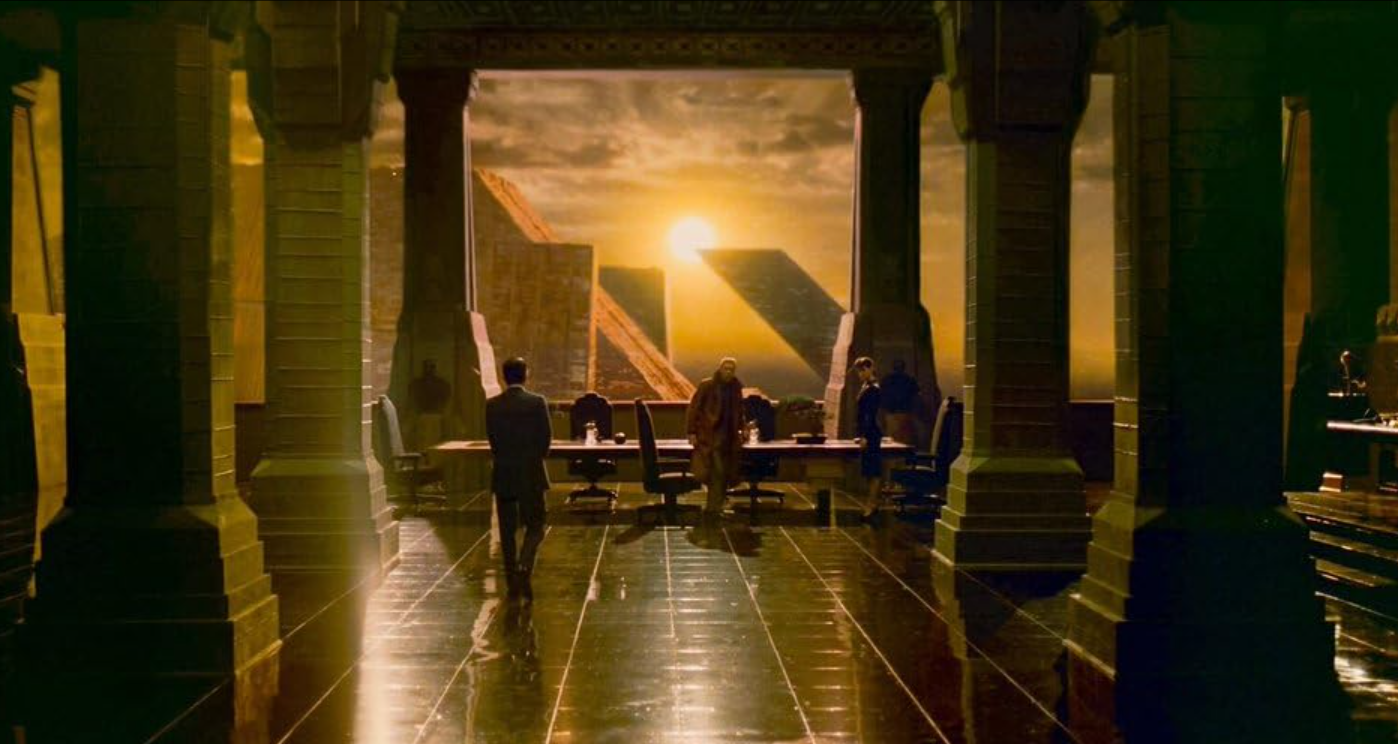
Their outsized role in today’s world has already led to any number of stories and movies. These always start with the idea that a single company, led by an (always reclusive) billionaire, has invented some technology that supposedly frees humanity from some alleged evil — physical toil, disease, death — but has accidentally or on purpose resulted in the despoilation of the planet and the enslavement or murder of vast swaths of its inhabitants. To take just one example, in the movie “Blade Runner” (1982), a robotics company has created androids impossible to distinguish from real people, but has made them too smart, and now they’re rebelling. The company’s founder lives at the top of a golden pyramid, surrounded by his creations, while ordinary people live on the ground in a grimy urban warren.
The latest iteration of this fascination with billionaires is “Mountainhead,” a TV movie just released on HBO Max. Its writer and director is one Jesse Armstrong, creator of the hit HBO series “Succession,” which itself spent years exploiting the public’s simultaneous fascination with and revulsion toward the uber-rich. I wonder whether Armstrong did this movie because there were some aspects of wealth he hadn’t yet explored, or because he’d pigeon-holed himself into the genre. Whatever the reason, he had a chance here not only to satirize his subject, but give them a comeuppance, and in the latter, failed.
The premise is this: four tech company founders who are long-time friends gather at the mountain aerie of one of them for an annual poker game. One of the guests, Venis by name, is the world’s richest man, having given users the ability to generate deepfake videos that are impossible to distinguish from real videos. The latest release of his technology has led to worldwide riots, ethnic cleansing, savage bloodletting, and the collapse of economies.
For the most part, the gathered friends see this state not as an emergency to shut down, but an opportunity to exploit. One of them, Jeff (Ramy Youssef) has retained some semblance of conscience: the violence worries him, and he makes constant sarcastic comments intended to puncture Venis’s weird, affectless presentation. He also owns a technology which provides “guardrails” that assists people in distinguishing false videos and fake news from the real. The other two attendees are Randall, an eminence gris played by Steve Carell, and Hugo, aka Soups (Jason Schwatrzmann), in the role that Carell would have played 20 years ago: the “poorest” among the quartet who constantly yes-mans Venis and Randall, the group’s whipping boy. (One of the only really smart things about the script is that his inferiority is balanced by the fact that it’s his Bond-villain mountain retreat where the group gathers: at least, he can occasionally assert himself by reminding the others that it’s his house.)
The satire is fun for the viewer, if you can stomach a lot of male razzing where the vocabulary and intent is someplace in between the board room and the locker room. A work that excludes women — and not even in a way that is funny — is just a sausage party, and a white one (although it would have been worse if they had made one of the characters a token non-white individual). One of the attractions of movies and TV shows about the uber-wealthy is a voyeuristic gaze at their possessions, but the mountain aerie is so bland and undistinguished that even the characters make fun of its ugliness. So the viewer is denied even this pleasure.
But if you can get past the general lack of imagination, the movie is fun until the third act, when the tension among the rich guys devolves into an actual physical struggle which is 1) all too foreseeable, and 2) not well directed enough to be funny or engaging. (A really good example of staging and directing a physical conflict is the Act II sequence in “Anora”1 when the two goons invade the home of the Russian oligarch’s son and his new American wife, aka the protagonist. The resulting struggle is an absolute classic of slapstick and advances the plot.)
And even worse, the movie thinks that the main conflict in the movie — the one that it chooses to make a stab at resolving in the end — is Venis’s destructive deepfake vs. Jeff’s software antidote. The real conflict is not between these twats, since they’re essentially all alike, but between them and the rest of the world. I would have liked the ending to show the equivalent of villagers with torches and pitchforks ready to besiege the castle. But there isn’t even a suggestion that the world is pushing back against these would-be emperors. So if you don’t find the glib satire satisfying in the first place, there’s really nothing left.