Review: Cat Person (2023)
Movie turns quirky, viral short story into a she-said thriller
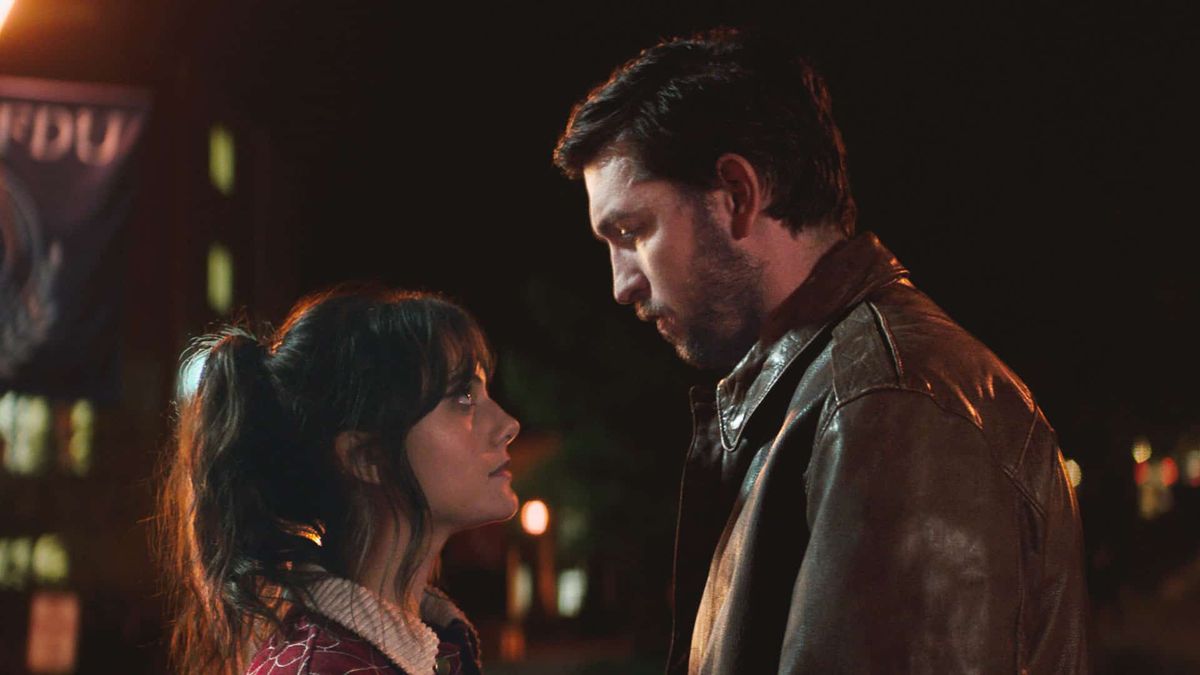
Cat Person (2023)
Directed by Susanna Fogel
Written by Michelle Ashford, based on the story by Kristen Roupenian
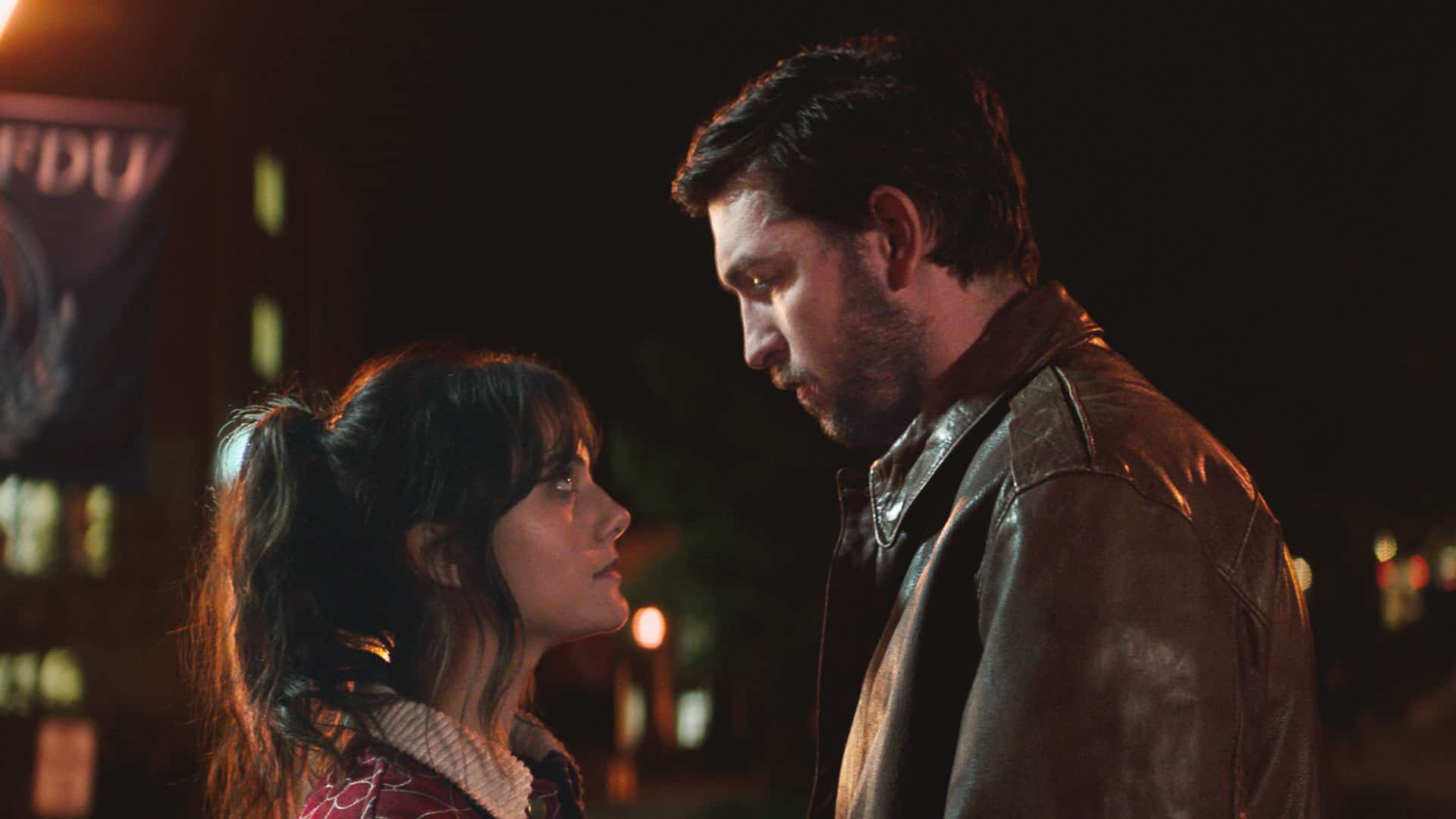
Almost everyone who would see “Cat Person” knows that it’s based on a short story that appeared in the New Yorker in 2017 (which seems much too long ago to be true, but it is; not just “this timeline” but time itself having been broken by the twin disruptions of Trump’s presidential term and the COVID pandemic). The story, by Kristen Roupenian, depicts the arc of a relationship between a young woman and a somewhat older man as being cursed by a number of factors: the young woman’s particular hangups, the man’s social awkwardness and self-centered nature, by both characters’ overthinking and self-consciousness, and above all, by what seems to be the poisoned state of affairs between heterosexual men and women that makes even dating, much less a stable relationship, seem like an impossible project.
The short story went viral because of its au courant depiction of modern romance in the #MeToo era not only as farce but as tragedy. Everyone read it — everyone of the type of people who read the New Yorker or write creatively or are invested in the sexual politics of the #MeToo era — and the story went viral. By which we mean it became “part of the discourse” — it became, for a few weeks, exhibit A in the ongoing discussion of sexual-economic-political issues that was #MeToo. (Meanwhile, Roupenian got $1.2M for her debut story collection, goodness knows how much for the film option, and is now a regular book reviewer for the New Yorker.)
The paragraph which you have just read is not only a statement about what the story came to mean in popular and academic culture. The paragraph itself, with its diversions and scare quotes and dependent clauses, typifies the critic’s dilemma: how I, and many others, find it impossible to make a declarative statement without reflecting on context. I can’t say “it was published in 2017” without being struck by the sense that 2017 was too long ago for this to have happened and that there are reasons it feels that way to me. I can’t use the contemporary cliché “the discourse” without reflecting on why we need this ironic tag for the way so many of us interact and react online, which is increasingly the dominant way that we react and interact at all. And, to get closer to the point of this review, these hesitations and side explanations, despite the way they clutter my sentences, seem necessary for what might be similar reasons that the characters of the short story, and the film, have their difficulties.
As I said, in the story a young woman meets a socially (and, it turns out, sexually) awkward man, flirts with him via text, and dates and sleeps with him, ignoring numerous warning signs that tell the reader, and should tell her if she weren’t ignoring them, that it’s never going to work. She then backs out of it, and we witness his reaction. Their entire relationship from start to finish is cringe-worthy, and the author combines many tropes of modern dating with dictums and observations from the #MeToo movement, demonstrating the hopelessness of not only this particular fictional relationship but any prospective heterosexual relationship. One way of saying this is that modern men lack the emotional education and the necessary maturity and empathy to enter into a relationship, and that modern women are increasingly aware of not only men’s handicap in this regard but of the various threats to their emotional and physical safety that results from it.
In short, dating sucks because men suck. This is perhaps only the most trivial conclusion that resulted from the #MeToo discourse, which covered everything from workplace sexual assault to critiques of the patriarchy to women’s access to health care and the increasing legal and institutional assaults on it. The chief villains may have been Harvey Weinstein and Donald Trump, but the critique on a personal level quickly extended all the way down to individual women’s relationships — present, past, and future — with individual men. The discourse was aided by Twitter and other online tools, as well as in-person discussions that women had amongst themselves.
The short story, and the film, depict the results of this discourse: an increased awareness among women of the depressing state of things, and for some an increased sensitivity to the micro-aggressions — to use a term that feminists borrowed from the discourse around race — that women endure on a daily basis.
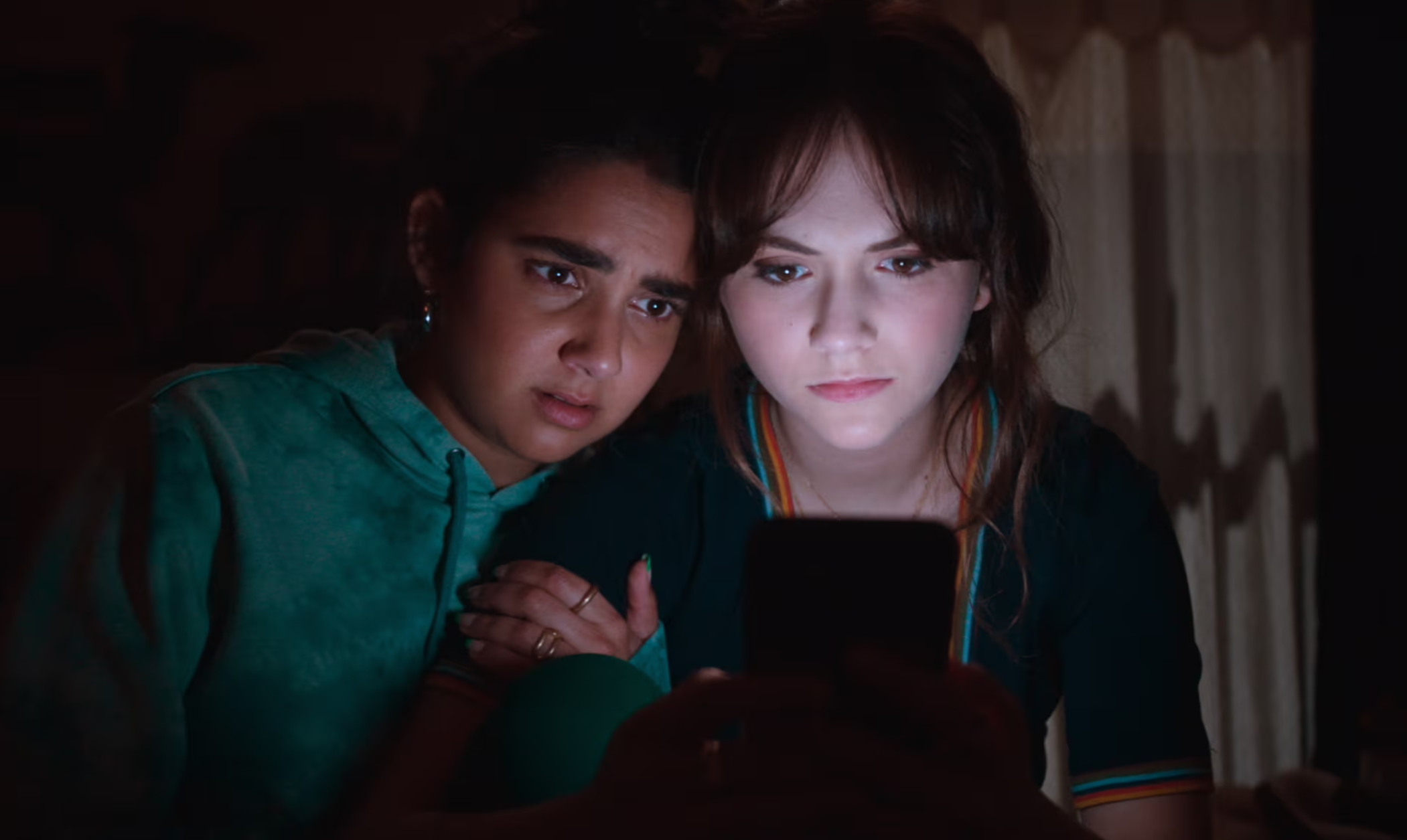
In this adaptation, the filmmakers decided to emphasize the most fraught elements of the story and, crucially, the #MeToo discourse from which it sprang. Thus a story that has as its subtext the possibility of violence that underlies the relations between heterosexual men and women makes that subtext explicit. The possibility of violence is emphasized and made scary; what was subtext in the story is extended to its logical conclusion.
The film opens with two young women, college roommates. Margot (Emilia Jones) is an ingenue who works at a concession stand in a college town cinema and is studying anthropology. Taylor (Geraldine Viswanathan) is hyper-aware of the #MeToo discourse and its implications for women, especially with regard to their psychic and physical safety. She runs an online forum in which women discuss the presence of the patriarchy in their lives. She’s all too ready to dismiss a man who evinces even the slightest inclination to be one of the bad ones; in this formulation, every man is a bad one until proven otherwise, and the bar is extremely high.
Thus when a customer at her job begins flirting with Margot, and they begin texting each other, Taylor takes on the role of feminist conscience. She seems to take it for granted that Margot will not keep in mind all the lessons that women have learned about men, and every time this man — an awkward, tall but unattractive guy with an ugly chin beard — commits a microaggression, Taylor is there to comment “Gross!” or “Eww!!”
Margot plays along, mostly in a joking way, with Taylor’s constantly issued scruples and cautions, but she’s lonely. The only thing in her life besides her job selling popcorn is her close relationship with her professor, played by Isabella Rossellini. So when the man, Robert (played with a combination of unctuous superiority and almost touching awkwardness by Nicholas Braun), proceedes to court Margot, Margot lets it happen. He kisses her, and despite the fact that he’s terrible at it, she allows him to think that they’re growing closer, an impression she only encourages by text message during a return to her parents’ house.
Nearly every stage in Margot and Robert’s relationship contains numerous but mostly small red flags. When they go to the movies together — a Star Wars film of his choice in which the first kiss between Princess Leia and Han Solo is for Robert the epitome of film romance (and Harrison Ford the epitome of coolness) — she lets him dominate the conversation instead of making her reactions heard. When they go for a drink afterwards, he says something belittling about her choice of a campus bar and, in a way that he intends to sound cool and adult but comes off wooden and cringe-y, tells her he’s going to take her someplace better. The date winds up with them having sex back at his house (she comments that she’s never dated a man with his own house before, and he confesses that he is not 25 as he originally told her, but 33, and by this time viewers are wondering if that too is a lie). By the time they’re having full-on sex, she’s disassociating. A critical version of her appears at the foot of the bed saying “You don’t have to do this! You can leave right now!” But she goes through with it all.
I haven’t said this so far, but director Susanna Fogel has, up to this point, directed the film like it’s a horror movie. The moments in which Margot is, potentially, physically vulnerable — such as when Robert visits her, unannounced, when she is alone in the anthropology lab at night — are presented as if this is a horror movie instead of a romcom. It’s as if the director is set on presenting as reality the fearful version of life that Taylor is trying to impress upon Margot.
This is the main weakness in “Cat Person” — Margot’s choices seem less to issue from anything in her psychology or history, and more because a horror movie requires the main character to make bad choices, thus subjecting herself to the horror that is in store. We don’t understand why she doesn’t heed all of Taylor’s warnings, given that they all seem to come true. We don’t understand why her conscious side doesn’t listen to the part of her — visible only in the divided version of Margot who sits at the foot of the bed and jeers while she’s fucking Robert — that knows better.
In any case, after the bad sex, Margot can’t ignore anymore the fact that the whole thing has been a bad idea from start to finish, and Taylor prevails, if only because she literally snatches Margot’s phone away from her and sends Robert a breakup text. After this, they watch together in revulsion as he decompensates in a single string of text messages sent several days later that begin with a friendly “Hey, let’s talk, I’d just like to clear the air” and, in the absence of any response from Margot, deteriorate into criticism, name-calling, and rage.
This is basically where the short story ended, and we feel the movie’s done a good job of making explicit both the circumstances and the reality of feminist #MeToo discourse. But because this is a horror movie, it has to go the rest of the way. A night of bad sex and a stereotypic acting-out on the man’s part isn’t enough; the script throws Robert and Margot back together, and this time she’s truly in danger.
Many reviewers criticized the movie for adding this additional sequence. My feeling is, if you’ve decided you’re going to make a horror movie, then it’s only logical that you take it all the way. After all, the whole approach of the film is to use the conventions of the horror genre to illustrate, in a macro way, the microaggressions caused by male maladjustment and insecurity. Why not follow this choice to its logical conclusion, while remaining within the possibilities of Robert’s character? — namely that he is, at bottom, a fuck-up, a tragically ineffectual dork who has to lie about himself in order to start a relationship. That dork is not a psycho-killer. Nevertheless, Margot finds herself — no, puts herself — in a life-threatening situation.
“Cat Person” is guaranteed to make its viewers uncomfortable. The characters’ actions and words are invariably cringe-worthy, and viewers will cringe throughout; I found myself wanting to skip the most uncomfortable moments of some scenes. This points up another weakness in the script. The best script has a viewer rapt. It never occurs to its viewer to skip bits because the experience of watching the film is one of constant surprise. When this is the case, the film creates trust in the viewer as it goes along, trust that each scene will develop in a cleverly original way — even in a film that causes a reaction of revulsion, fright, or yes, cringe. The reward of seeing how the filmmakers will fulfill this bargain you’ve made with them is the movie’s compensation for you enduring negative moments.
Despite these weaknesses, the film is very good on several levels. The casting and performances are excellent. Emilia Jones really captures the contradictory way a young person can be smart and naïve at the same time; Nicholas Brown embodies the lurching awkwardness of his character, and establishes just the right level of emotional sincerity, causing you to feel a little sympathy for him while at the same time realizing he is at best a dipshit and at worst a rapist. (All men are rapists at their worst, or at least that’s what they say; the only thing to judge is not their most dire potential but their best, and Robert just doesn’t have much of the latter to show.)
Isabella Rossellini appears here lending gravitas to another small role; I just saw her in “Spaceman,” the Adam Sandler sci-fi movie recently (and deservedly briefly) in theaters, where she played the prime minister of a Czechoslovakia that had developed a space program. And it’s always a pleasure to watch Geraldine Viswanathan, who just appeared in “Drive-Away Dolls” and previously in 2019’s “Bad Education;” her character here is a bit one-dimensional, but her rubbery face and comic timing make her a great screen presence.
“Cat Person” is available for streaming on Hulu and other platforms.