Review: Day of the Fight (2024)
Good-looking film from a John Huston grandson could have used a better script
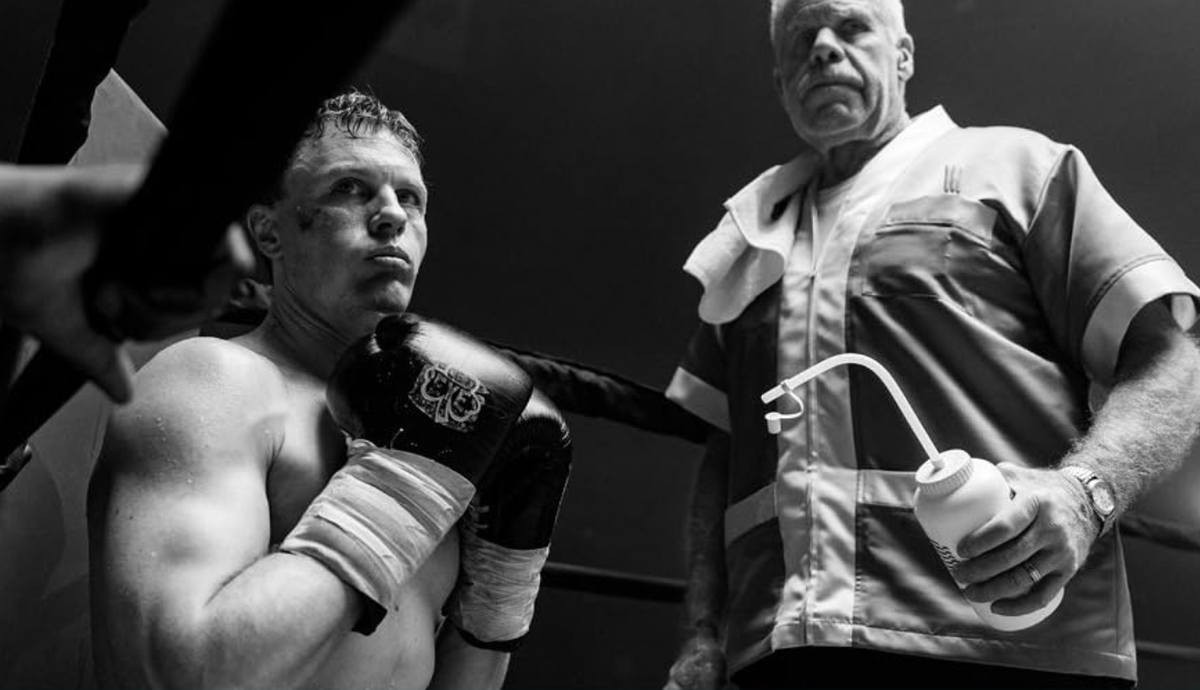
I've been waiting to see this film from the grandson of famed director John Huston for most of the year. I heard about it six or eight months ago and put it on my watch list, but when it failed to show up in theaters, I thought it had gone straight to streaming, or even video. This made me fear that “Day of the Fight” might be a dud, since most talked-about films that end up not being released in theaters usually have a few things against them, and most often one of those is the film’s quality.
And there's also a thing with movies made by the descendants of great filmmakers or actors where they can get all kinds of Hollywood stars to appear in their shitty movie. I’m thinking the actors do it as a tribute to their former coworker -- that is to say, the ancestor of whoever is making the film. Despite the star power, the movie itself turns out crappy because the son or grandson or whoever of the original guy has very little idea how to shape a movie.
The 1993 movie “Mad Dog Time” is a prime example. Get a load of this cast: Gabriel Byrne, Jeff Goldblum, Ellen Barkin, Gregory Hines, Diana Lane, Kyle MacLachlan, Billy Idol, Richard Dreyfuss, Burt Reynolds, Michael J. Pollard, Henry Silva, and Richard Pryor. Some of them in cameos, sure, but in the early 90s you still expected something from a movie starring Gabriel Byrne. The problem was that the movie was directed by one Larry Bishop, who had a number of grindhouse acting credits to his name but whose primary claim to the privilege of directing a film was that he was the son of Rat Pack member Joey Bishop. (Thus the inclusion of Henry Silva, who appeared alongside Bishop the elder in the original “Ocean’s 11.”)
The resulting movie — which I think I only saw by locating a VHS tape on eBay, and I only took the trouble because I was writing a book about the Rat Pack — was really, really terrible. It had some attempt at a gangster noir milieu and story, but there was no story, no plot. It was a strung-together pastiche of scenes like Let’s See How Great Diane Lane Looks in This Dress, or What If a Lounge Singer Pulled Out a Rod and Started Shooting. An utter mess.
So a similarly star-studded lineup in “Day of the Fight” — Michael Pitt, Joe Pesci, Steve Buscemi, Ron Perlman and John Magaro — far from being an encouraging sign, had the opposite effect on me. A neophyte director, related to a famous figure, and lots of stars chipping in?
But when finally this debut feature -- written and directed by British actor Jack Huston, who is known to American viewers for his roles on HBO’s Boardwalk Empire and AMC's Fargo, and who is a grandson of the great director John Huston -- showed up at a San Francisco multiplex, I made time to see it.
As the title “Day of the Fight” — also the title of an early Stanley Kubrick short from 1951 — suggests, the film shows the life of a prize fighter who is preparing for a bout that night. Mike, played by Michael Pitt, is a now washed-up former middleweight champ who lost it all when he t-boned a car while driving drunk, killing its occupants and earning him a prison sentence for manslaughter. As the film opens, he’s been out of prison for a while, long enough to get back in shape to fight — which he’s not supposed to do, given the head injury he sustained in the car wreck.
Somehow his manager and trainer Stevie (Ron Perlman) has set up a fight for him to challenge the current middleweight title holder, and the fight is scheduled for that night. He spends the day as if it were his last on earth — which given his dangerously damaged cranial blood vessels, it might very well be. He looks up acquaintances and old girlfriends, makes amends, and places a large bet on the match. He’s a 40-1 underdog, but fortunately the bookie is a friend of his.
It’s not a bad premise. Could be terrible in the wrong hands, great in the right ones. One problem is that the viewer quickly realizes that most of the movie is going to be one scene after the other where Mike visits someone who was important to him, and they have a moment; then he goes on to the next. I think the worst scene in the film is the first of these, where he goes down to a Brooklyn shipyard to talk to a childhood friend played by Steve Buscemi, who is absolutely terrible here. I mean none of Buscemi’s line readings are convincing — it’s like he forgot how to act. This reveals the first-time director’s inexperience. Maybe he felt intimidated by the star and couldn’t challenge him to do better; maybe Buscemi was having a rough one and Huston felt sorry for him.1 Whatever the reason was for allowing this performance to see the light of day, it is not an encouraging sign for the audience.
But meanwhile we’re getting used to the images by Huston and cinematographer Peter Simonite, and to be sure, it’s a good-looking film. It appears to be in black and white, but some of the images seem to have a complicated depth of tone which made me feel like they were shot on color film (or video) that was rendered to black and white somehow? I don’t know what I’m talking about when it comes to cinematography, but the movie does look very good.
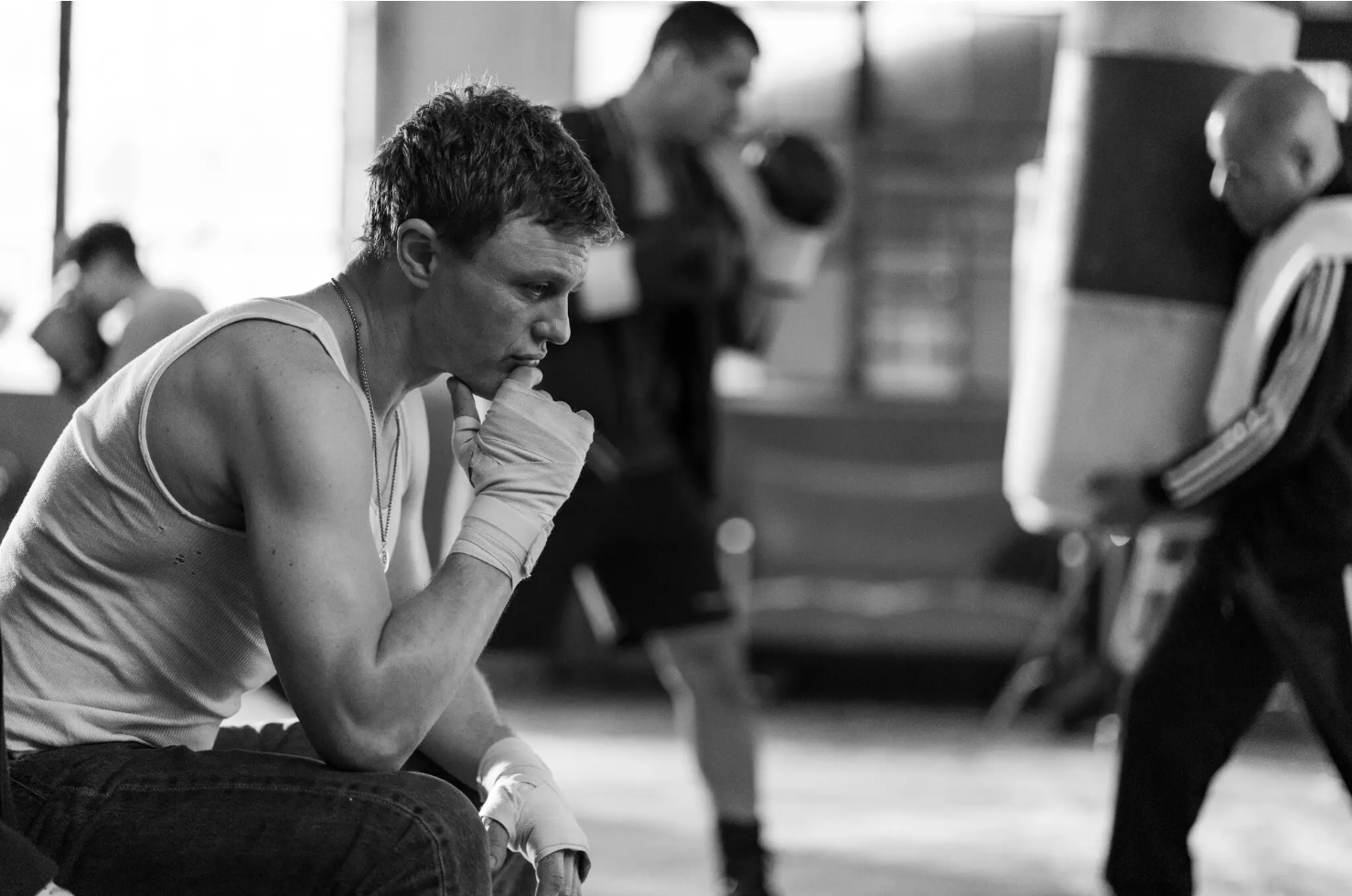
Shooting dialogue scenes, which account for much of the movie, is one thing; shooting the boxing match is another. To the credit of both Huston and his star — Huston wrote the movie with Pitt in mind — the boxing match is great looking, well-paced, and exciting. I don’t know enough about boxing to be able to say how realistic the portrayal is, but it was convincing enough for me, and provides a fine climax.
Michael Pitt is good; he’s neither hammy nor colorless. He’s not the greatest actor, but he is believable as his character and in the ring. Better are Ron Perlman — always a reliable presence — as Mike’s manager and corner man, and especially John Magaro as a boyhood friend turned Roman Catholic priest. Though hampered by some weak dialogue writing, Magaro saves the scene with Mike by exuding stillness and realness and multiple complex layers of personality that are not in the script but are in the character as embodied by Magaro. That’s just good acting.
Magaro, who was a standout as the third wheel in the Oscar-nominated Past Lives and showed up Steve Zahn in a starring role in the obscure LaRoy, Texas, is emerging as one of the best performers in movies today. His stature and nonstandard visage may prevent him from becoming a leading man, but frankly there’s probably more work available to someone who is a great supporting actor. He appears in this month’s movie about the 1972 Olympics massacre, “September 5.”
Despite its weaknesses, I enjoyed this film. Some of the images have real power, and the ending is beautiful — and not dark, as I had expected.
This article on Den of Geek quotes Huston on how he got Buscemi for the film. Buscemi took SAG minimum and gave the director, whom he knew from HBO’s Boardwalk Empire, one day, on the first day of shooting. This helps explain why Buscemi’s segment seems weak — Huston and the crew hadn’t gotten their rhythm yet. ↩