Review: Perfect Days (2023)
Wim Wenders redeems himself with a minimalist narrative that's surprisingly moving
Perfect Days (2023)
Directed by Wim Wenders
Written by Wenders and Takuma Takasaki
Only a few days ago I was ready to write off the lion’s share of Wim Wenders’ filmography for having gone soft and sentimental following the trauma of “Hammett” and the subsequent success of the magical-realist “Wings of Desire.” Wenders proceeded to mistake sentimentality for emotion, I said, and posturing for acting, and a lack of narrative development for simplicity.
Why, then, was I so moved by his Oscar-nominated (in the international film category) “Perfect Days,” which was said to be the story of a simple janitor and his simple life, which sounds exactly like the sentimentality and lack of plot that I criticized less than a week ago?
Here’s the thing. A single human being, performing only their everyday routine, can carry an entire film. It’s been done before — the film “Jeanne Dielman, 23, quai du commerce, 1080 Bruxelles” (1975, directed by Chantal Ackerman) is one classic that’s been brought up by way of comparison with this movie, and I would also name “Fallen Leaves,” last year’s deadpan Finnish romcom directed by Aki Kaurismäki, as another. All you have to do as a filmmaker is take the lead character absolutely seriously, and have a fantastic lead actor who does the same and is utterly present in the moment.
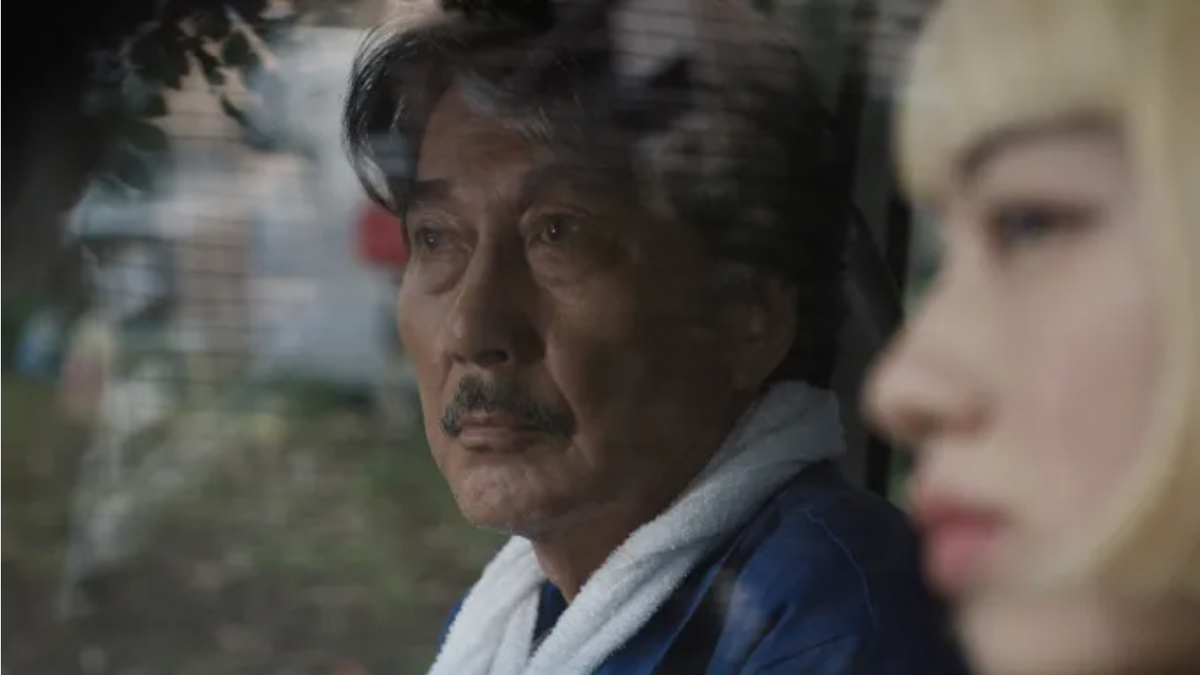
In “Perfect Days,” this description fits perfectly. Koji Yakusho, a well-known Japanese actor who looks to be in late middle-age (the actor was 67 when the film was shot), may be somewhat more handsome and well built than we might expect a Japanese toilet cleaner to be — but there’s a reason for this, we learn about 60% of the way through the film.
Here’s the summary. Yakusho plays Hirayama, whose simple life is filled with his job — he works for a project called The Tokyo Toilet1, which during the pandemic snazzed up the public parks in the Shibuya district by commissioning popular architects to design and build distinctive new public toilets, and his job is cleaning and maintaining these facilities — and the ordinary details of a private life. He lives simply and does the same things every workday, and every day off he does day-off things — his laundry, errands, a weekly visit to a certain type of bar that exists in Japan, run by a middle-aged woman who maintains a joking, informal relationship with her middle-aged or older customers. He works diligently and with dignity, never indicating that the work is beneath him. During his lunch breaks he sits in one of the parks and eats a sandwich. He looks up at the sunlight filtering through the leaves of trees and takes pictures of it sometimes, trying to capture its ineffable quality.
That’s his life, repeated with great regularity. The work and the routine don’t become oppressive to him. He lives in a state of grace.
A few things happen to ruffle this peaceful life: his young co-worker (Tokio Emoto, in a broadly comic turn) gets a crush on a beautiful, sylish girl (Aoi Yamada), who takes a liking to the 60s and 70s rock that Hirayama plays in his tiny truck as he drives from one park to the next. (The soundtrack2 of the film is pretty great.) Hirayama’s teenage niece appears at his downbeat apartment, needing a break from her life. When her expensively dressed mother appears a few days later to reclaim her in a chauffer-driven car, we get a glimpse not only of the girl’s life but of the family that Hirayama belongs to — not one where cleaning anything for a living, much less toilets, is a thing.
The film offers no explanation, but the episode creates a whole context for Hirayama’s character, without ever referring again to the vast social difference between his past and his present. The viewer is left to fill in the story, if they wish to. And that’s how minimalism works: the film offers only a few clues — the chauffer, the sleek car, the well-dressed woman, her facial expression and the pain in her voice when she asks “Are you really cleaning toilets?” — and the viewer fills in the rest.
Not to be confused with a lack of narrative. In “Lisbon Story,” there’s nothing to understand, and events appear random. Here the film, and the actor himself through his preparation, understands everything while showing only shadows and sunlight, filtering through the trees.
The end of the film is a long closeup of Hirayama as he drives to work, Nina Simone’s “Feeling Good” playing in his truck. Across Hirayama’s face passes every human emotion — pain, love, anger, joy. I was surprised at how moved I was.
https://tokyotoilet.jp/en/ ↩
https://en.wikipedia.org/wiki/Perfect_Days#Soundtrack. The track that the girl likes is “Redondo Beach”by Patti Smith. ↩