Review: Secret Mall Apartment (2025)
Is it art, or just a treehouse?
Secret Mall Apartment (2025)
Directed by Jeremy Workman
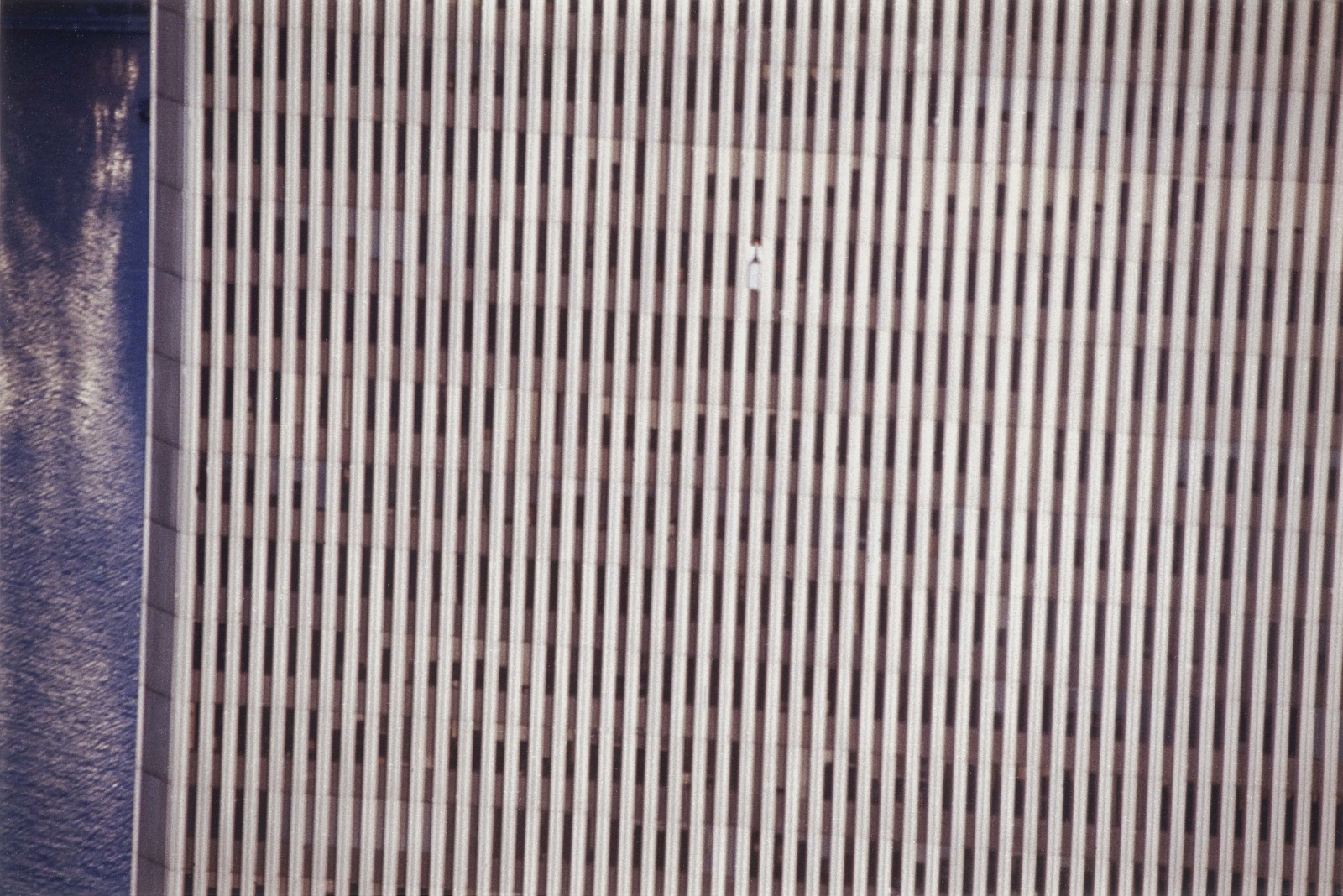
In 2000, before the World Trade Center was destroyed in the events of Sep. 11, an Austrian artists collective executed a remarkable act of subversion there. Through a program that supported the arts at the vast office complex, they gained access to a tiny office on the 91st floor of one of the WTC towers. There they constructed a car-sized object that they could hang on the side of the building. When they were ready, they surruptitiously spent the night in the office. At dawn, they removed a window from the office and installed the device they had made. It was a tiny balcony, portruding from the side of the skyscraper only a foot or two. A co-conspiritor had gotten a hotel room across the street and took a few photographs to document the achievement. Then they removed the device, replaced the window, and had breakfast.1
That feat, as well as the now-legendary tightrope act performed by Philip Petit in 1974 and other acts of defiance2, is art, because it interrogates and subverts the real and imagined qualities of the site. The WTC — despite, or maybe because of the 1993 bombing that had killed six people and injured hundreds — was thought to be impregnable and featureless, over 100 stories of uninterrupted vertical lines. The balcony, which was on the side of the building for only a few minutes, punctured its façade, literally and figuratively, and made everyone who noticed it, or heard about it later, reconsider what the WTC actually amounted to.
The new documentary “Secret Mall Apartment” is about how some former Rhode Island School of Design students responded to the demolition and gentrification of their warehouse district. In an event experienced by many an artist or artisan, their funky art studio/performance space/makeshift loft in a ramshackle building in an old warehouse district met the wrecking ball of capital. Michael Townsend and his fellow artists were evicted, and the old warehouse was demolished in favor of a new development.
Meanwhile, an enormous, brutalist concrete mall was being completed nearby in downtown Providence, R.I.; in fact, the new mall was what made real estate developers think the whole area was ripe for redevelopment. Instead of fleeing this monstrosity, Townsend, an artist and Rhode Island School of Design instructor who was celebrated locally for working with patients at a children’s hospital to adorn their rooms and hallways with whimsical murals, allowed himself and his friends to be swallowed by it. They hung out at the mall constantly, eating cheaply (or not paying at all by consuming left-behind portions of other patrons’ food-court meals) and shopping at a Goodwill Store.
Townsend had closely observed the mall’s construction. Because of its unusual setting on a riverbank and by a busy railroad, the enormous building was constructed in oddly-shaped sections, and this had produced a void within the structure. Already something of an urban explorer, Townsend found ways to access the mall’s back passageways and superstructure. Soon he was leading his friends on a sort of revenge art project: If the mall and the changes it had wrought resulted in their evictions, then it owed them one: they would establish a secret pied-a-terre within the mall’s negative space and live there on and off. This documentary doesn't actually put it in terms of revenge, but that's how it seems to me. By literally occupying the mall, they were taking back what it had taken from them.
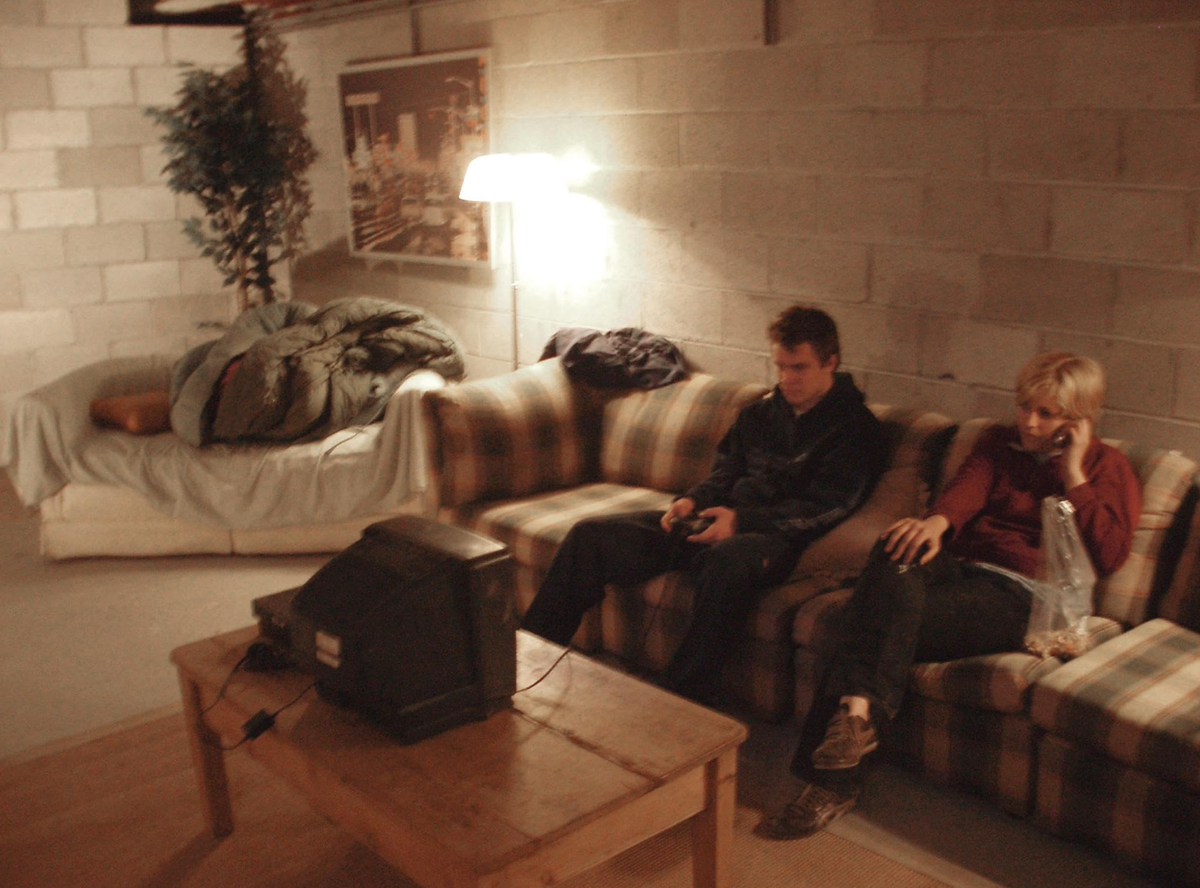
They accomplished this over the course of a couple of years, with a certain amount of giggling, captured by small, cheap video cameras that they carried around. This grainy footage is blown up to usable film and provides an acceptable document of their hijinks, I mean their art project. But is it art?
Whether or not the establishment of a secret mall apartment -- or a simulation of one -- actually constitutes art is a question the film does attempt to address, to some extent. Chiefly, the conflict is most meaningful in the relationship between Townsend and his girlfriend and fellow artist Adriana Valdez Young. As faithfully recorded on their video cameras, they confront the issue while relaxing in the mall's food court. After several years of devoting his energies to the apartment, he still seems to be just as gleeful about the project as ever, but she's getting tired of it. When she says “I don't want to spend more time making the mall apartment better. I want our home to be better. I want to spend time on it,” I got the feeling that Townsend wasn’t lifting a finger to care for the actual apartment they both lived in. The filmmakers also interview Townsend’s current girlfriend, and she, too, is perplexed about what differentiates the project from, say, a treehouse.
That’s the closest the movie comes to a critique of Townsend and his mall apartment. Mostly it presents him in a flattering light, working with kids at the hospital and in New York City to memorialize the victims of 9/11. The film expects you to be delighted by the whole idea of the “secret mall apartment” and the youngsters’ efforts to create and decorate it, but one of them comes closer to the truth when they describe it as “prison-like.” There are, of course, no windows, and to use the bathroom the artists have to travel through maze-like passageways to enter the mall proper. Most significantly, all the electricity is from extension cords leading who knows how far away to outlets, and clearly there’s never enough power to make it an actual work space for artists — which seems, you know, ironic. I like cool improvised spaces and tiny houses and so on; they appeal to almost everyone. But if it wouldn’t work for me to actually write in, I wouldn’t be that interested. Isn’t actually doing your work the whole point?
What makes the secret apartment less successful as art than the WTC balcony is that its critique of the mall and what it represents is muted. The Providence artists took over a space that was unused and essentially forgotten, and made little use of it themselves except as a clubhouse. No one was really housed in the apartment.
What I found most meaningful was the way the artists formed a community to carry out what was essentially a sabotage mission. There’s nothing like working on a project together to make new friends, a phenomenon that helps countless volunteer organizations survive and also provides a key motivation for people joining more negative groups like criminal gangs. Humans are preternaturally social. They form bonds with one another. Despite the triviality of mall apartment project as depicted, the biggest takeaway is that it’s rewarding to form affinity groups, no matter what you’re trying to accomplish.
Thanks to Bob Ostertag for the link to the publicdelivery.org article where the picture of the WTC balcony appeared. Bob’s new book is “Encounters with Men” from Black Lawrence Press.
“Balcony Scene,” by Shaila K. Dewan, New York Times, Aug. 17, 2001. https://www.nytimes.com/2001/08/18/nyregion/balcony-scene-unseen-atop-world-episode-trade-center-assumes-mythic-qualities.html ↩
“City Lore: Learning to Love the World Trade Center,” by Tara Bahrampour, New York Times, Mar. 4, 2001. https://www.nytimes.com/2001/03/04/nyregion/city-lore-learning-to-love-the-world-trade-center.html ↩