Review: The Card Counter (2021)
written and directed by Paul Schrader

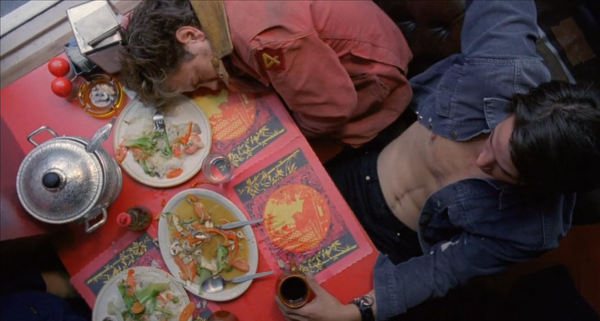
Above: Oscar Issac, Tye Sheridan
The Card Counter (2021)
written and directed by Paul Schrader
The way Hollywood defines redeption is that a character either defeats the person or force that originally traumatized him. But Paul Schrader, writer and director of "The Card Counter," defines it in religious terms: redemption is expiation for sins as a prerequisite to salvation.
Oscar Issac plays William Tillich, a former Army private who participated in the atrocities at Abu Gharib and did time for it -- unlike, pointedly, the officers in charge. (Whether history supports the notion that the officers in charge were not punished, I don't know.) Now out of prison, he drifts across America like the Flying Dutchman, going from casino to casino and supporting himself from his winnings (he spent his time in prison learning how to be an expert blackjack and poker player). He still suffers PSTD from Abu Gharib and writes a nightly journal interrogating himself about the evil things he did there. His winnings are enough to get by on, and he seems to be keeping his demons at bay. But when he's approached by a young man (Tye Sheridan) who is the son of one of the men Tillich served with, he's drawn back into direct confrontation with his past.
He's also recruited by a mysterious woman named La Linda (Tiffany Haddish), who represents anonymous investors. They want to stake him as a professional poker player and split the winnings; he points out that the risk in that scenario falls entirely on the player, who's responsible for repaying the stake when he loses. But he agrees in order to generate enough money to pay for the young man to get out of debt and go back to college.
Clearly Tillich is doing this as a way to save not only the younger man but himself. But here the film starts skipping steps in the thematic development department -- the redemption scheme is only implied, not explicit, even though the film is explicit about many other, less consequential issues, and also wastes a lot of time on moody walks through casinos or nighttime drives on the highway accompanied by a foreboding soundtrack, half ballads and half electronic horror-movie thumping and buzzing. So there's time to do this essential thematic development. The film simply neglects it, as well as other plot points that beg for explanation and resolution.
The character's name, Tillich, is an obvious reference to 20th century Protestant theologian Paul Tillich, whose theological and philosophical thought is beyond my understanding; I can't hang with even the Wikipedia article devoted to him. So for someone like me who can't figure out the direct line from the theologian to the film's protagonist, I'll just have to take it on faith that Schrader attempts to draw one.
Lacking this, the viewer must make the most of the script and Oscar Issac's performance. His character is completely closed off and impenetrable for the first 20 or 30 minutes, but once he acquires the young man and La Linda as companions of sorts he opens up, and Issac allows the character's personality to poke through like sunlight through a damaged roof. This process is interesting in itself during the film's middle section, and when it begins to be necessary for plot points to occur they're almost an intrusion. I found myself almost fighting to not follow plot events so I could pay attention to the characters.
As a movie about gambling it's pretty good. It shows, clearly enough, blackjack and poker play to support the story. But despite the title, the movie really isn't about blackjack. For a movie that's much more explicitly about card counting and blackjack, see "21" (2008, directed by Robert Luketic).