Review: The Marvels (2023)
The Marvels (2023)
Directed by Nia DeCosta
Imagine a huge mural or fresco, hundreds of feet in width and at least 100 feet high, that depicts an enormous series of historical events. The Bible, say, or Ovid’s “Metamorphoses,” or the Mahabarata, with creation stories, warring gods, rising and falling empires, and world-changing events. The mural would have to be extremely detailed and depict all the major characters and events found in the work, along with as many minor ones that can be made to fit. A storyteller could stand before the mural and use it to illustrate a talk about the stories depicted there, as their listeners gazed upon the images and learned the story of their race.
Thanks for reading Too Beautiful! Subscribe for free to receive new posts and support my work.
Somewhere there must exist such a mural for what has become known as the Marvel Cinematic Universe, a series of movies (now numbering over 30) depicting a cast of characters and a series of events whose narrative complexity — especially when you include all of the backstory events — is beginning to rival that of the examples cited above. A single Marvel employee, one Kevin Feige — who as the keeper of the Mavel cinematic canon and the executive producer of all Marvel movies is the equivalent of a showrunner1 for the franchise — maintains this mural. I don’t know if the mural really exists, or what form it takes, or even if it’s simply all in his head.2 But the task of a Marvel movie fan is to acquire a knowledge of the franchise that nearly equals that of Feige. Then that fan can view a new addition to the franchise armed with all the knowledge of who all the characters are, and what happened in previous stories as, invariably, the new movie begins in medias res.
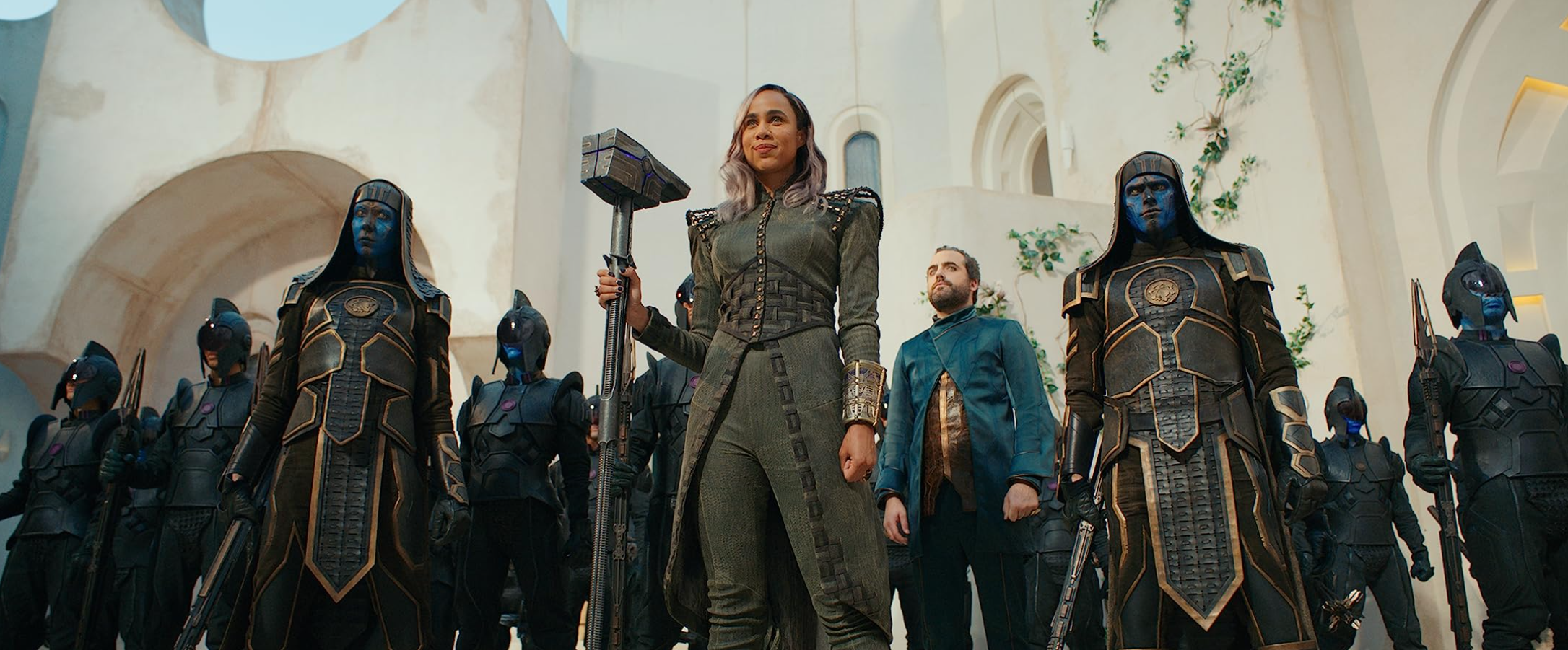
I’m not that fan; “The Marvels” is only the second Marvel movie I’ve ever seen. So when this movie began I had no idea who the blond lady with the giant hammer-thingy was, who she’s fighting, or why. I didn’t know who the “Skrull” people were — aside from her enemies — or why they were refugees; they visually coded as bad guys because they look like goblins. Then one of the main characters, Captain Marvel (Bree Larson) is introduced. She lives on a space station — no, a relatively small spacecraft — with a cat, and seems to take orders from Samuel L. Jackson, who wears an eyepatch and lives on a different space station.
There is no opening crawl, no lines of dialogue explaining the story’s background for viewers. (also, no titles). Obviously, anyone not already up to speed is at a disadvantage. Fortunately, those explanations in dialogue do eventually come — but not until about a third of the way through the film.
So you have to just let things wash over you for thirty or forty minutes, content to watch the characters flying around, blasting each other with crackly light beams, and performing other super-powered feats without doing what we commonly expect superheroes to do: use their super-powers to intervene on behalf of ordinary people against evil. It seems that this role is now passé, except on a planetary scale. The three “Marvels” and their antagonist jump from planet to planet using gateways in space-time, performing deeds not against or for individuals or nations, but a world’s entire population and biosphere.
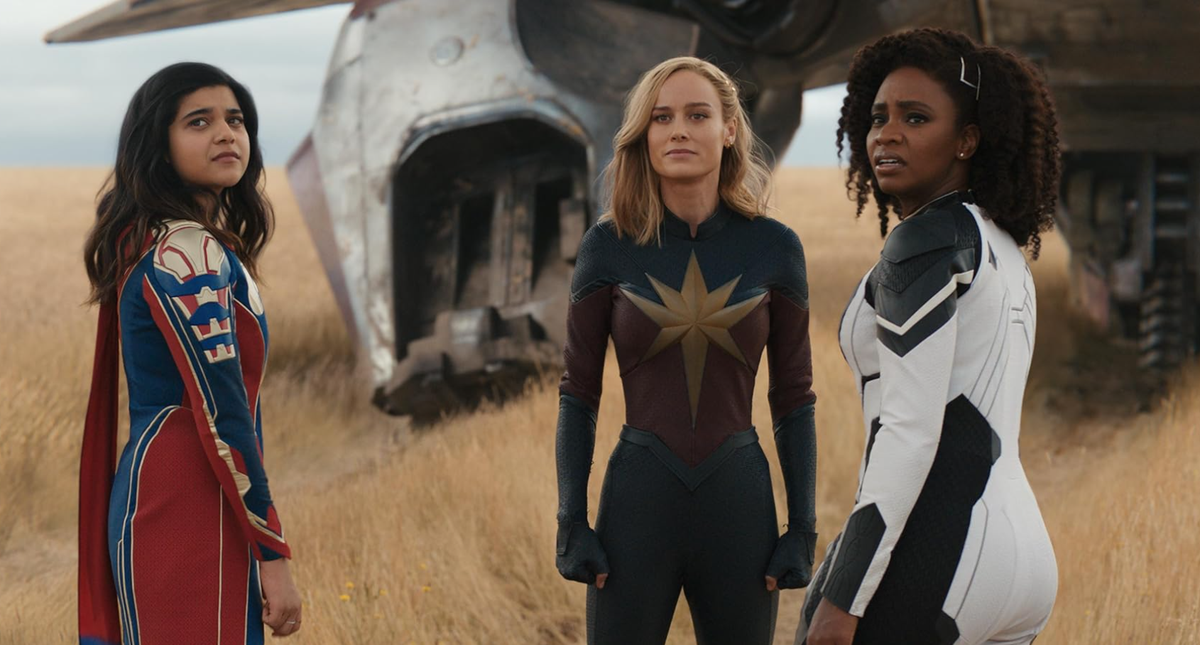
After many of these scenes, we finally get the plot: Dar-Benn leads one set of bad guys, the Kree. Her goal is to acquire two “quantum bands” — powerful objects which, in ancient times, were used to create the system of gateways used to travel across the galaxy eliding time and distance — primarily to restore the Kree’s depleted home-world by stealing one planet’s atmosphere, another planet’s oceans, and Earth’s sun. She digs up one of these MacGuffins in the film’s first scene. The other belongs to Kamala Khan (Iman Vellani), a teenager in Jersey City, NJ, who uses its power to become Ms. Marvel, one of the superheroes in the titular trio.
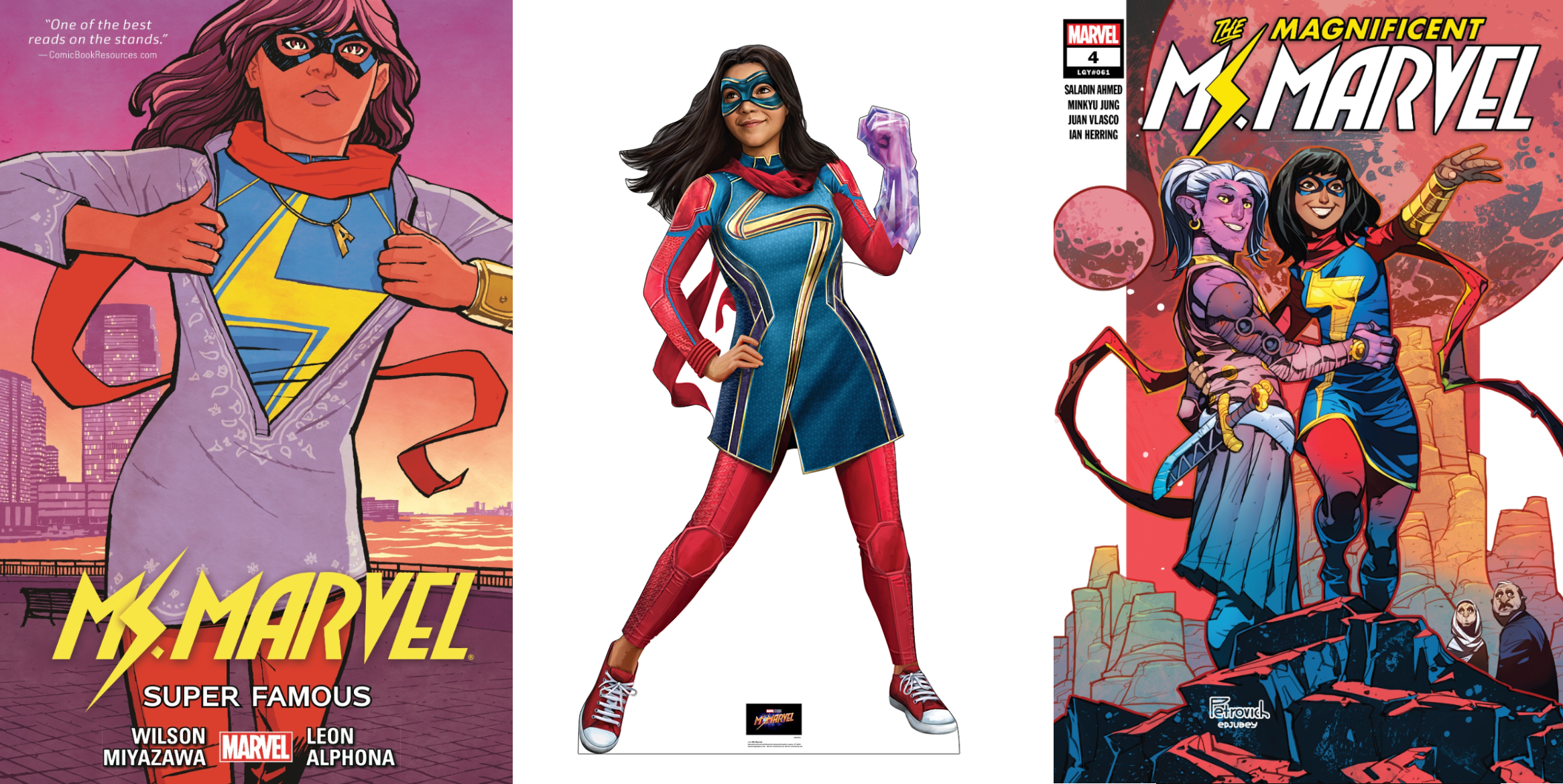
Ms. Marvel was the only character I knew going in. I don’t remember how I learned about the character, but I’ve read a lot of “Ms. Marvel” comic books and watched the Disney+ TV series “Ms. Marvel” that was released in 2022. I enjoyed especially the plot arc in the comics in which she fights against right-wing developers who want to gentrify Jersey City. I knew that the comics plots wouldn’t appear in a film like this, but the movie does feature some extended scenes in the middle-class Muslim home of Kamila Khan’s family.
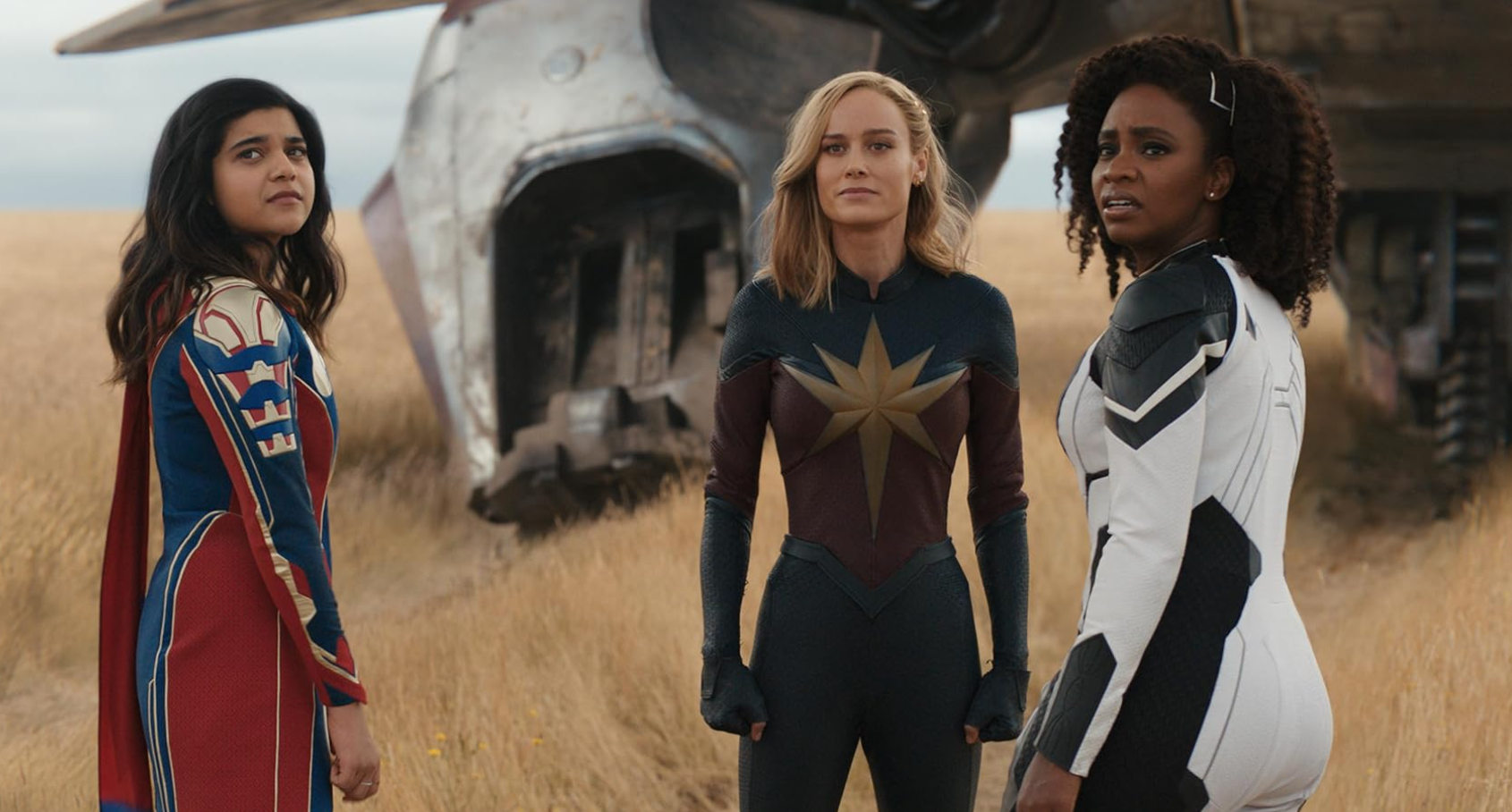
In addition to Ms. Marvel and the previously-mentioned Captain Marvel (Bree Lawson’s character), a third character played by Teyonnah Parris completes the titular trio. There’s little backstory given for Monica Rambeau. The mos tinteresting thing about her is that despite being able to perform some super-powered acts, she has resisted becoming a full superhero with a costume and a name (though halfway through they all acquire fresh superhero costumes). Best I could figure out, Rambeau served with Carol Danvers — Captain Marvel’s alter-ego — as a pilot in the military; when we first see her, she’s an astronaut. You’d think that a super-powered person’s rejection of the superhero role would make for an interesting story in itself, but this movie doesn’t have time for it. What is given of her backstory is collapsed into a scene where her mother, who has befriended Carol Danvers, dies of cancer.
The movie is not about that, but about Dar-Benn’s quest for Khan’s “quantum band,” and the havoc she wreaks before and after getting it. In this the film resembles the only other Marvel movie I’ve ever seen, “Avengers: Endgame,” which is also about a bad guy character’s quest for magical objects and what happens when he finally completes the set. I guess when you’ve made 32 previous movies set in the same milieu you have to repeat something.
This film does have one great set piece. When it looks like they’re about to be blown up, everyone has to evacuate Samuel L. Jackson’s space station. The problem: they only have a shuttle that can carry 8-10 passengers. So they utilize the herd of cats that live on the station, cats which have the unnerving ability to extend long tentacles from their mouths and devour things and people; fortunately, the cats can later spit out what they’ve consumed. So to evacuate the space station, Jackson sics the cats on the station’s crew, because it’s easier to fit cats on the shuttle than people. This results in a farcical scene in which the station’s crew (who are not aware of how this will save them) flee screaming from the cats, which quickly devour them anyway, set to a recording of “Memories” from “Cats,” the Broadway show. (YouTube clip) (It would have been even better if the song had been sung by Samuel L. Jackson during the sequence.)
Like all Marvel movies, this is for adolescents, but includes jokes for the adults, such as the “Memories” song. In Marvel movies, as in the comics, the characters mutter jokes and self-effacing comments while performing their superheroic feats. This is only one way “The Marvels” was bearable where “Argylle,” which I saw the evening before, wasn’t.
I viewed “The Marvels” at a strange theater in the basement of a huge casino-resort in Reno, where I now live. The Grand Sierra Resort began life as a Reno manifestation of the MGM Grand, a Las Vegas casino-resort. Among the many attractions of the development was a movie theater, constructed in the basement of the complex to show movies from MGM’s library.
That was the story told to me by the theater’s owner, who happened to be manning the place by himself due to a staff illness. Now called the Grand Sierra Cinema, the twoplex features second-run movies for $6 a ticket. So I was able to see “The Marvels” on the big screen, even though it has disappeared from most theaters and is only available to view, like all Marvel movies, on Disney+. One of the things I appreciated most was that the theater did not have Dolby sound. I could actually watch a superhero movie without earplugs.
In television, a showrunner is the head writer and (usually) executive producer of a series. They ensure that a staff full of writers stays on track with character arcs and the overarching plot arcs of the series, and are essentially the series’s auteur. The term isn’t used in film, but considering Feige’s role in the Marvel on-screen brand, not to mention other long-running series of hit films and their sequels, it may as well be. ↩
In this article it’s said that Feige merely jokes about “needing a whiteboard” to keep track of it all, so I guess the public doesn’t really know. ↩