Review: The Room Next Door (2024)
In his first English language film, Pedro Almodóvar brings bright colors to a muted story in which a dying woman asks a distant friend for to accompany her to death's door
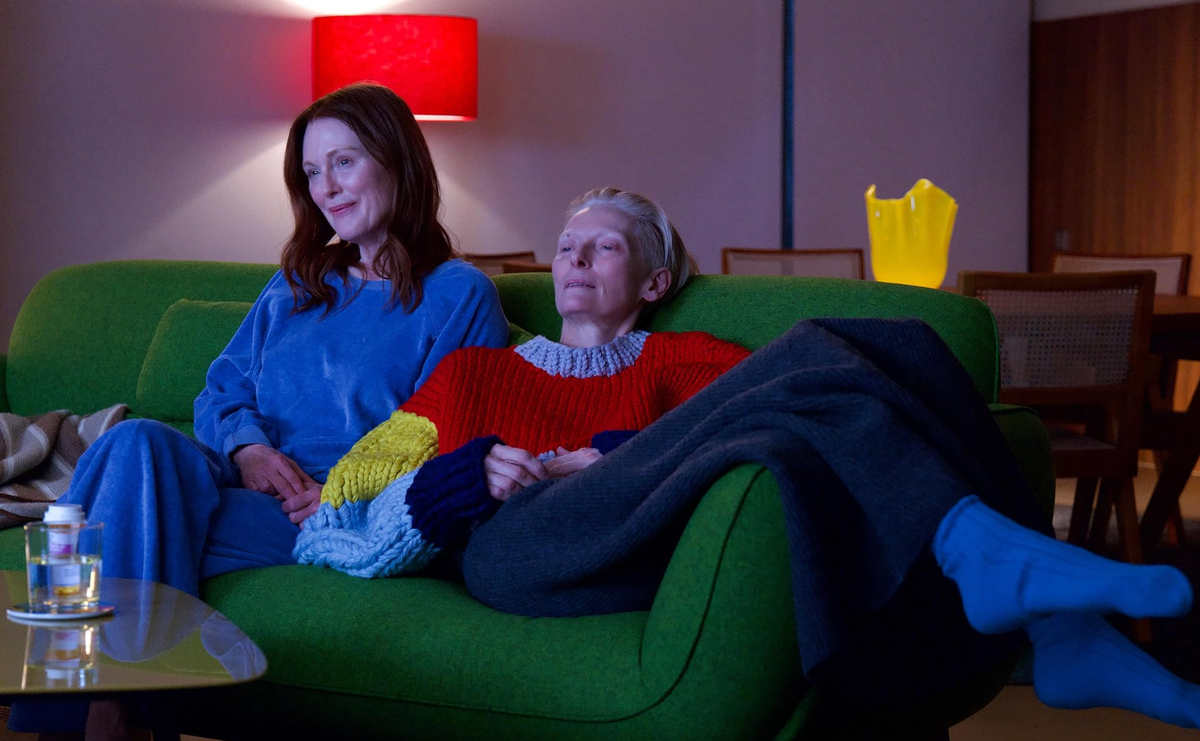
The Room Next Door (2024)
Written and directed by Pedro Almodóvar
from the novel by Sigrid Nunez
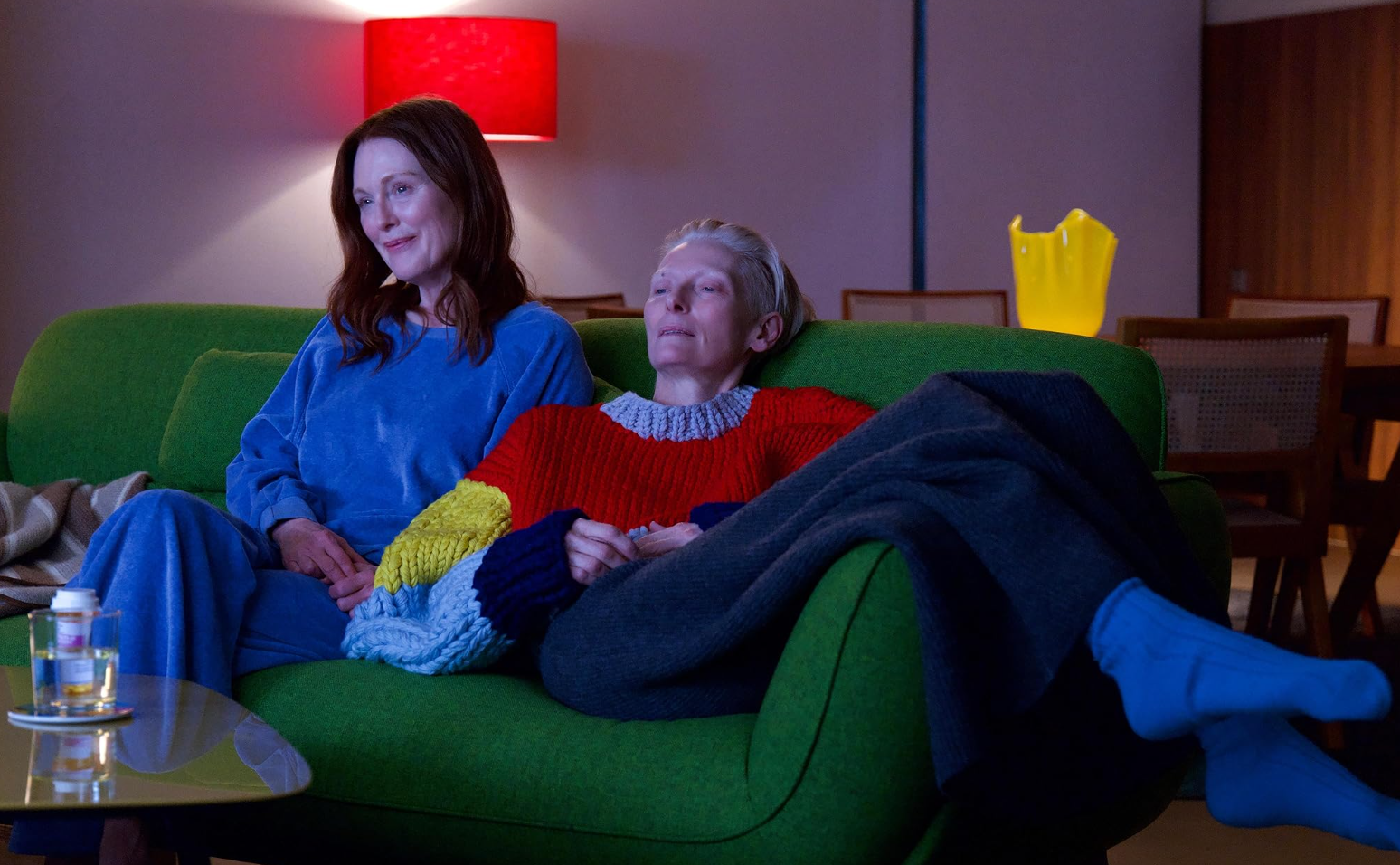
Not every shot in the latest film by the great Spanish director Pedro Almodóvar is as drenched in bright, solid colors as the image above, but many are. In one scene Julianne Moore, who plays a nonfiction writer, wears a green sweater so fluorescent it might as well be emergency gear, while Tilda Swinton’s character, a former conflict journalist with terminal cancer, chooses a smashing acid-yellow coat to wear dying. Even in the hospital, Swinton’s outfits are color-forward, if that’s a term.
One expects a certain indulgence in fashion from Almodóvar. Even in this East Coast setting, with both British actor Swinton’s and New Yawk actor John Turturro’s accents ironed into a standard flat American accent that wouldn’t be out of place on a network newscast, no one wears clothes that are old or unstylish; everyone’s sweatered and scarfed to the hilt. I was reminded of “El Affaire Miu-Miu” (2024),1 a narrative short sponsored by Prada in which even rural small-town residents whose only role is to stand and watch a plane come in for a landing are swaddled in thick, stylish wool caps, sweaters, and scarves. But unlike that Argentinian short, the clothes in “The Room Next Door” are not for sale.

In the film, Swinton’s character Martha, the war correspondent, decides on death with dignity, buying a suicide pill on the dark web. She and Ingrid (Moore) are former close friends who haven’t seen each other much since the raucous days of the New Journalism in the 80s. They get reacquainted during Martha’s hospitalization, and though she has closer friends, it’s Ingrid whom Martha asks to accompany her to death’s door. Well, actually she asks her closest friends first, but they all say no, so it falls to Ingrid.
The narrative rarely ventures outside one’s stereotypical expectations of a dying-lady melodrama, though Almodóvar does air things out early on with flashbacks from Martha’s youth: A returning Army veteran boyfriend with PTSD fathers a daughter who soon becomes estranged from Martha; then the vet suffers a flashback when he happens upon a blazing house fire and hallucinates calls for help. He runs into the house and dies in the blaze. This action sequence, uncharacteristic for an Almodóvar movie, is a welcome relief from dreary hospital scenes, no matter how colorfully decorated and styled — but it comes early in the film.
Once the two women repair to a rental house in the Catskills — no mere lodge, but an exotic multi-box structure (that is actually located in Spain2 ) — the only variation is when Ingrid takes a break in the nearby town. There she meets a third writer friend, Damian (Turturro), who incidentally is a past lover, decades before, of both women. No longer a trailblazing ecologist, he now writes, and rants, about the coming climate catastrophe so shrilly that suddenly we’re watching a Woody Allen movie, like the scene in “Annie Hall” in which Alvy Singer (Allen) can’t shut up about JFK assassination conspiracy theories, or the one in “Hannah and Her Sisters” in which Max Von Sydow goes on a rant about how stupid TV is. Viewers already have been keyed to think of Allen because of all the romantic glimpses of New York from Martha’s hospital room (even the views are curated), but the kvetching Turturro is a bit much.
Really this movie can be reduced to Tilda Swinton’s brilliant performance. She’s been onscreen for decades but, like Grace Jones — also an elongated screen presence — hardly ages. Swinton can do, and has done, characters in high camp productions by Wes Anderson or the Coen brothers, science fiction, melodramas like this one, historical dramas, and family dramas. Here, she fully inhabits a dying character, never once faltering. Moore, a very good actress, cannot keep up; she seems more like the straight man to Swinton’s lead, though the narrative is from Ingrid’s point of view.
To top it all off, Swinton appears in the last scene, thanks either to SFX de-aging or just makeup, as her character’s own estranged daughter. I sort of would have preferred seeing which young actress — Kiernan Shipka? — could do young Tilda Swinton.
You can watch it on YouTube: ↩
https://www.wallpaper.com/art/the-room-next-door-brutalist-house ↩