Review: The Settlers (Los Colonos) (2023)
Another country soaked with blood
The Settlers (Los Colonos) (2023)
Directed by Felipe Gálvez
The soil of every country in the Americas, from top to bottom, is soaked in blood. The history of each nation goes like this: When Europeans arrived, they took the land and its resources from its original, indigenous inhabitants using brutal and horrific violence. Only the details differ, from place to place. This history is often repeated again and again as successive waves of brutality sweep the land like storms.
Witness Chile, where Spanish conquistadores in the 16th century committed genocide against the Incas, where gangs hired by landowners conquered the Mapuche in the 19th and early 20th century, and where fascist death squads killed tens of thousands during the 1970s and 80s. It’s a wonder the rivers don’t still run red.
Two 2023 films, “Los Colones” (“The Settlers”) and “El Conde,” document two of these waves of death. We review the first here, and will treat the latter in a week or so.
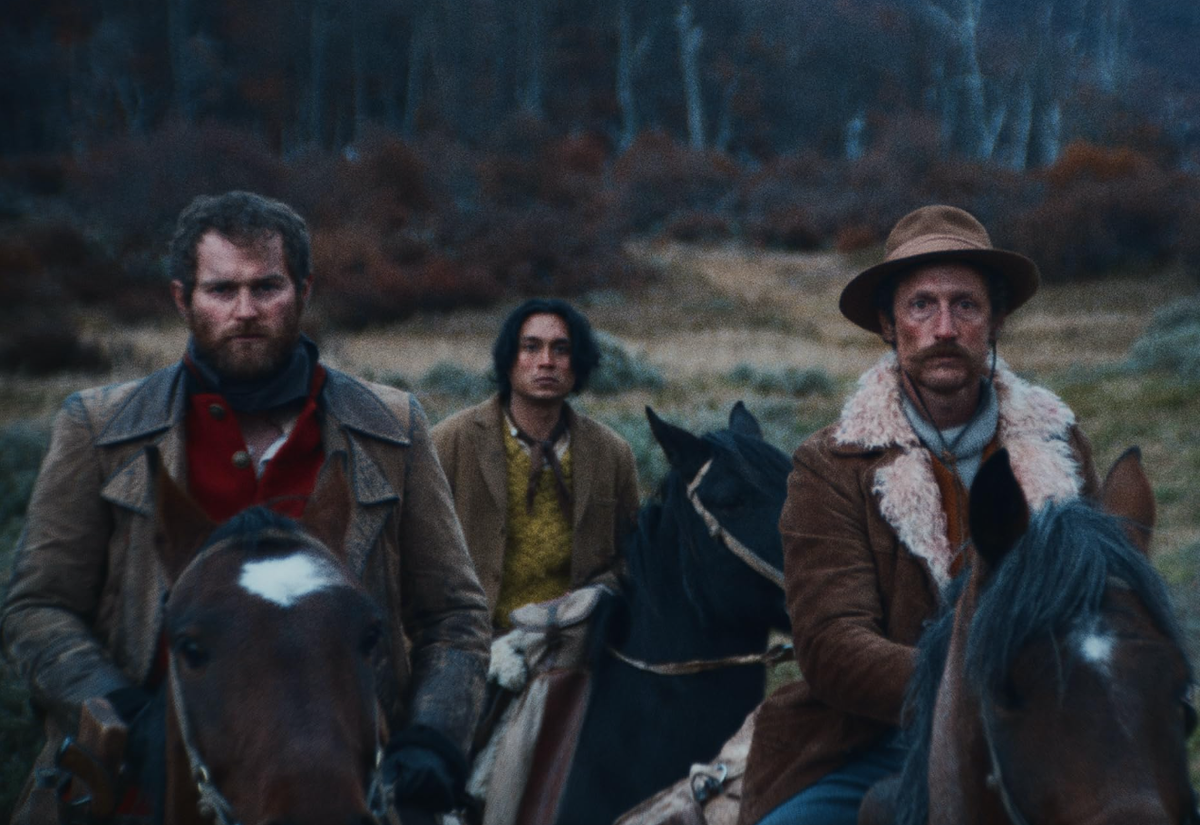
The film begins in 1901 at the southern tip of the country, where a crew of men — poor men from across the Western hemisphere, washed up in the end-of-the-earth archipelago of Tierra Del Fuego — are erecting fences for a powerful landowner named Menéndez. Something goes wrong with the operation of tightening the wire, and a worker loses an arm. As he lies sniveling on the ground, he pleads that he has “only lost an arm,” but is shot on the spot by an overseer, who declares “A man with a missing arm is missing entirely” — something like that, I was too shocked to set the exact phrasing to memory. The point is that, seeing as how both the murderer and the victim are British, being white won’t save you.
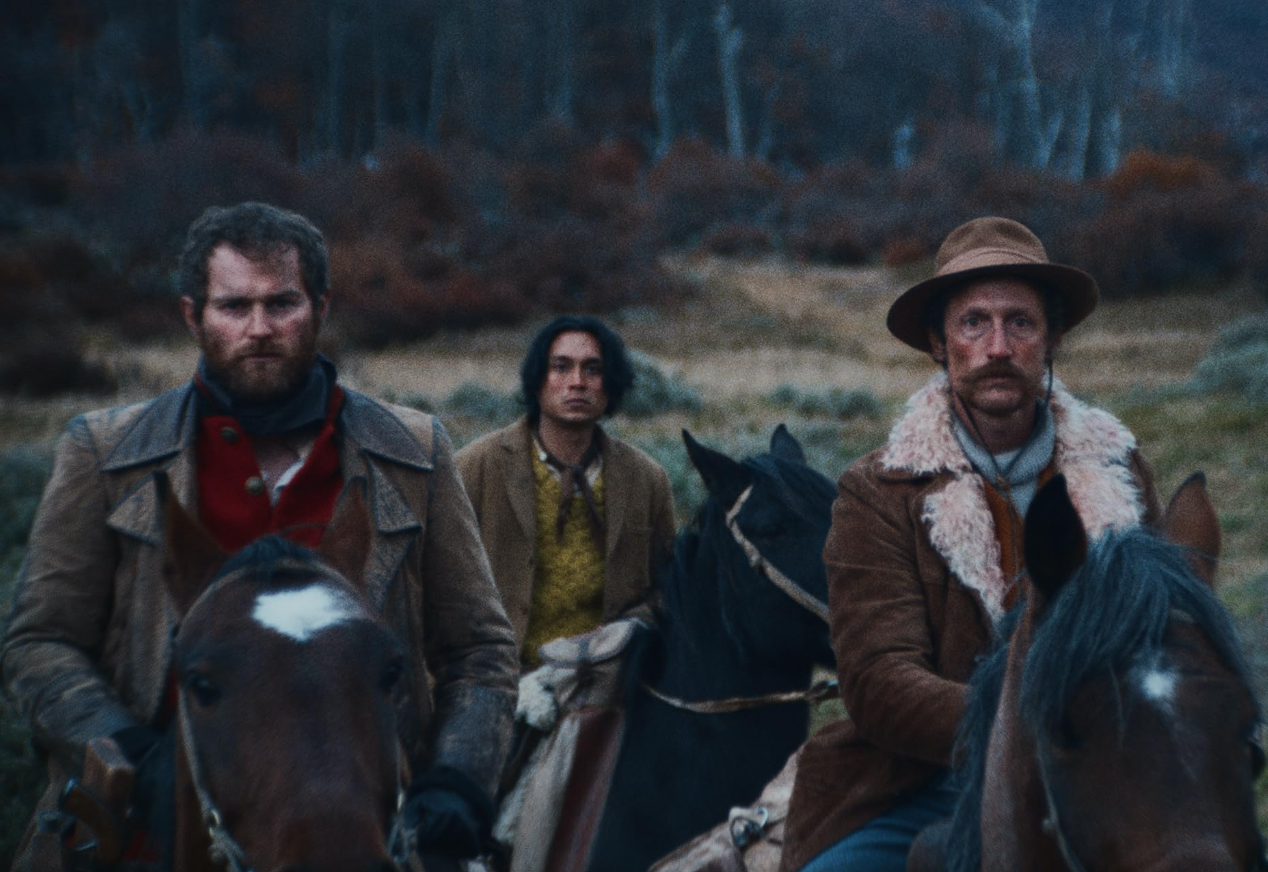
Witnessing the swift death is Segundo, a Mestizo worker. Segundo becomes the eyes and ears of the film, as Menéndez assigns him to go with the overseer, MacLennan, and an American cowboy named Bill, to seek out a route across the Andes to the Atlantic so the landowner’s sheep can be driven to market.
At first, their journey is merely picturesque; it felt to me at times like the opening of the Werner Herzog film “Aguirre, the Wrath of God,” in which conquistadores led by the certifiably insane title character, played by Klaus Kinski, search for El Dorado. The scale of the landscapes, dwarfing the men who crawl across them, creates a sense of awe in the viewer, if not in the characters. Both films make an explicit connection between brutality, violence, and a certain level of insanity, as if to say that it takes a monster to commit genocide. We know this not to be true, but in most films it has to be this way, to enable the audience to imagine a safe distance between its members and the violent people on screen.
The film quickly becomes the story of whether and how Segundo will survive the ordeal. Barely able to hold his head above the surface of the metaphorical sea of blood, he is tempted, during an attack on an indigenous family unit, to shoot his companions rather than the native Americans. As befits his mestizo self — half native, half white — he can’t bring himself to shoot anyone. He fires into the air.
After another extended sequence in which the travelers fall in with, then become the victims of, another gang of white men led by a British deserter, the movie mercifully jumps several years ahead. Menéndez is now elderly, but still the master of his domain. He is visited by an emissary of the faraway Chilean government, which is seeking to suppress the history of genocide on which the country was founded. MacLennan is long dead, it seems, and Segundo is living in peace by the sea. But the emissary must, in the end, seek him out and call him, too, to account for his actions.
This film is short, a mere hour and 30 minutes, but extremely powerful. The music by French composer Harry Allouche is a fitting accompaniment to the sweeping landscapes — his ironic Western theme is both familiar and accusatory — and to the scenes of chaos and brutality. The performances, especially by Mark Stanley as MacLennan and Camilo Arancibia as Segundo, are really great.
In theaters now; later available for streaming on Mubi.