Review: The Substance (2024)
Why are horror movies?
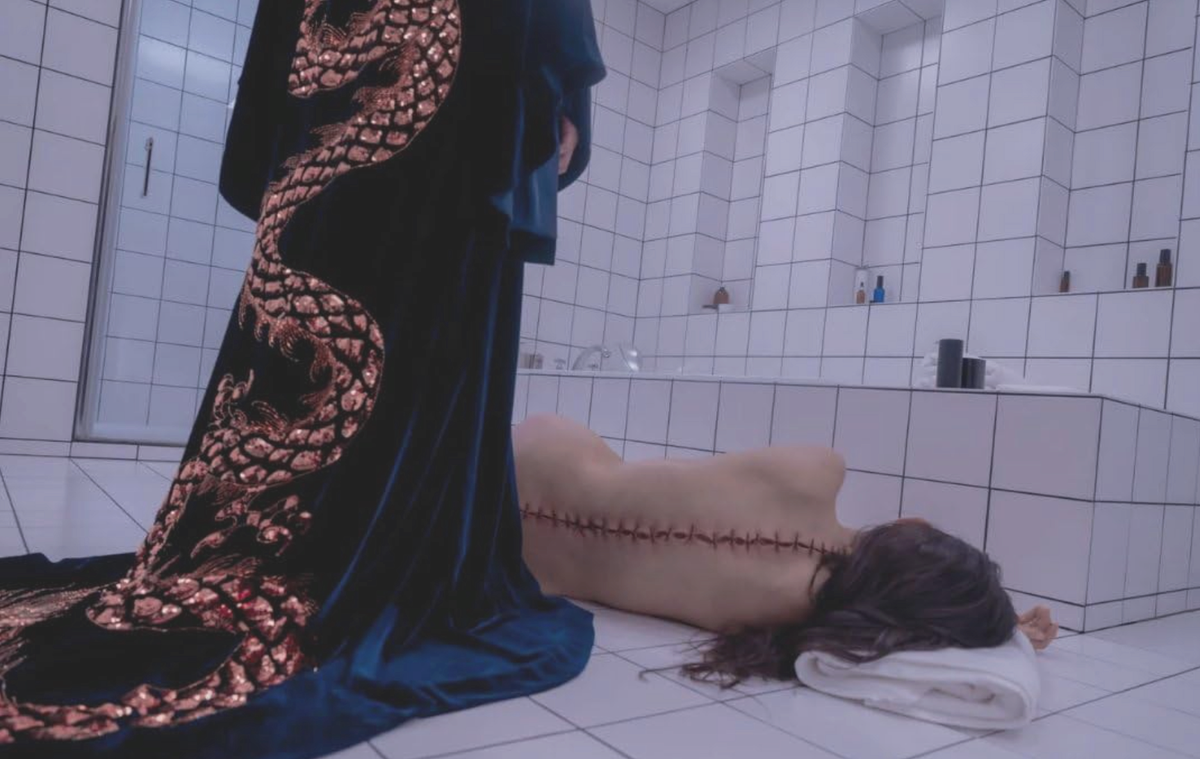
The Substance (2024)
Written and directed by Coralie Fargeat
This movie, the second feature by French director Coralie Fargeat, offers viewers the breaking news that Hollywood beauty standards are oppressive — and to illustrate this bold hypothesis, subjects its female characters not only to discrimination by a leering TV executive, but to physical degradation that defies what the human body is capable of.
The premise is pretty simple. Lizzie Sparkle, an aging Hollywood actress who once won an Oscar but whose last gig is doing a weekly aerobics workout show on TV, learns that there is a fountain-of-youth treatment that will allow her to exude — extrude? — a young and gorgeous clone of herself. Each of these selves, the 60-year-old original and the 20-year-old clone named Sue (played by Margaret Qualley), must alternate, with one resting and the other living, every week. If this schedule is not followed precisely, product might not work as expected.
Do they follow the schedule precisely? They do not.
That’s the whole thing in a nutshell; the shell, if you will, is that this takes place in a hyperbolically misogynist and surreal Hollywood that is also very stripped-down. When she’s fired from her workout show by a network executive played by Dennis Quaid, Lizzie (Demi Moore) doesn’t seem to have anyone to protect her — not an agent, not a lawyer, not even a friend. She lives alone in an enormous dwelling high above the city but which is also, curiously, an apartment building with hallways that look like every single apartment building hallway from Friends or Seinfeld. Similarly, when early in the movie she walks out of a brutalist concrete hospital into what seems like a futuristic sci-fi landscape, across the street everything’s normal. And then there is the seafood lunch being consumed by the Quaid character, his mouth in extreme close-up. Director Fargeat loves extreme close-ups.
These surreal details do provide a Brechtian sense of alienation and displacement, but they run counter to the simplicity of the premise — which is, again: aging Hollywood star chooses to use a fountain-of-youth treatment, followed by exactly the kinds of oh-shit consequences you’d expect.1 The story is an old one: Justin Chang of the New Yorker compared it to “The Picture of Dorian Grey.” But the surreal mise-en-scene and, when they arrive, the horror-show gore effects do nothing to enhance the story. They simply hang upon it, as if you went to the Halloween SuperStore and, instead of buying a costume, you took down the cheap decorations and wore them to work.
When a movie features some futuristic tech or fantasy element that doesn't exist in the real world, as viewers we're supposed to accept it. So it would be unfair for a reviewer to say that the youth/clone treatment on which the whole movie depends is not real. Within the world of the movie, it is real. What bothered me about the plot is that when she emerges into the world, Sue doesn't audition for a big film that could make her a star; instead, she goes back to the studio where Lizzie's aerobics show was produced and auditions to be her replacement.
I found this ridiculous, but on the off chance that Fargeat intends this to be a statement of some kind -- something on the order of women being trapped into limited roles -- it still doesn't make sense. The film itself, which offers a challenging role to Demi Moore -- who is rightly being recognized for it -- belies this assertion. Instead, it only makes sense when you consider that the film's world is extremely constricted. Sue pursues the aerobics show because in this world, that's all that exists of Hollywood. But that doesn’t make it a statement about Hollywood.
Many reviewers have described the movie as “feminist,” but simply depicting an oppressively misogynist environment where women are exploited and victimized is no longer enough to make a film feminist. The oppressed must be shown having agency, working together to understand and then change their plight. The conceit of the fountain-of-youth treatment, which requires Lizzie and her clone to cooperate to keep the other alive, would seem perfect for this. But instead they’re jealous of the other’s time; like Roy, the tragic villain of “Blade Runner,” they each want more life.
Does that change by the end of the movie, do they find a way to work together? No, their enmity grows, just as everything in this over-the-top movie expands until it explodes. So no, showing women at war with each other until they become homicidal isn’t feminist, nor is depicting their physical destruction.
If you’re looking for a feminist movie with horror touches, I recommend “Maxxxine” instead. Or “Blink Twice,” which isn’t about Hollywood per se, but which does show women uniting to revolt against male oppressors.
A word about the stars. Demi Moore holds down her role admirably, showing she has real acting ability and deserves better than this. Margaret Qualley has much less to do, other than be pretty; she was good in “Drive-Away Dolls” and soon something will come along to make the best use of her. Qualley is the daughter of Andie MacDowell, and casting MacDowell in the role of her clone’s “parent” would have lent the film an honest feeling of frission, but they didn’t.
Why are horror movies? Are they to provide some missing atavistic thrill, something that daily life no longer supplies, in the absence of saber-toothed tigers? Do they exist to break taboos of continence and privacy, because we somehow must see from time to time the gruesome details of what the body holds? Do they refill some internal reservoir of dread, as if daily life under the threat of fascism and climate change is not enough?
And why do people feel compelled to sit through them? With their shrieking soundtracks, filled with revolting moist noises and synthetic crashes, are they supposed to be some test of toughness? Are they some kind of desensitivity training so that when the warplanes begin to strafe your neighborhood, you’re somehow prepared for the noise? When you steel yourself to sit through gruesome scenes where someone is being dismembered or otherwise tortured, just what are you trying to prove?
And when, like “The Substance,” the movie is also bad, just what keeps you in your seat? I was impatient with this film starting about 10 minutes in; I put up with it for more than an hour before walking out. A few days later, I bought another ticket to see the ending, which a reader said made the whole thing worth it. Regrettably — because I would have loved to be proved wrong — having seen the film’s last 40 minutes, I have to disagree. It was pretty much more of the same, in the sense that the last reel simply continued the previous hour-plus ad nauseam. Very ad nauseam.
One point each for cinematic references to “The Shining,” “Carrie,” “The Thing,” “2001: A Space Odessey,” and probably others. Truth be told, I wasn’t watching that closely. I was cringing.
To be fair, the filmmaker’s approach — in which everything is overdone, and done further, and overdone again, and then done at least once more — means that there are a few consequences that you couldn’t anticipate. And yet, even when these come, they lack the sense of surprise; they’re simply what’s come before, only quadrupled. ↩