The New VP
Excerpt from an unpublished novel
The day Peter Chasten was named the new VP, I’d gone into the large meeting room early to make a phone call. It was my mother’s birthday, and grabbing a conference room is the only way to get a little privacy, even if you are using your cell phone. The alternative is to go outside the building, but then there are always people walking by looking at you, and I don’t know about you but I’d rather be invisible, or to be more precise, unseen.
My mother, who lives in a retirement residence in a town in Oregon, was 88. I told her that it was a very lucky number if you happened to be Chinese, and she said Well, there are no Chinese here. So I’ll be lucky if I get a fortune cookie. Sometimes it’s hard to follow the jumps her mind makes. She’s always been like that, but old age has conferred an even freer association. I sort of admire it.
I hadn’t bothered turning on the lights in the room when I’d entered the room to make my call. The trees nearest the window were already in the shade of the building, while beyond them sunlight lit up other trees on the perimeter of the office park, so that the dark conference room was filled with blue and green light, like being underwater. Then Cynthia and some other people came in and flipped on the lights, and I realized with a start that Jonathan had been in the room all the time, sitting quietly in a corner, staring out at the trees.
“There he is, the Road Warrior,” Donovan said, using Jonathan’s nickname. “He travels the highways in search of petrol, and winds up saving the world.”
“You’ll let us know when you get to that second part, won’t you, Jonathan?” added Geoff.
The room filled up with people as Justine wheeled in a cartload of food: baskets of cookies, boxes of energy bars, platters arranged with carrots and celery and dip. She went back and got more: Bagels, muffins, spreads, and several cardboard boxes each containing a gallon of coffee. Then as an assistant arranged it all on a side table, Justine ostentatiously bustled to the front of the room and dialed a conference line for the sake of Moment offices in other cities.
Strange as it may seem, people were not glad to see the food. A spread this big meant that management had something important to say, and that was rarely a good thing.
The bigwigs arrived: Albert, the Executive VP of the Moment software division, appeared with Robert, the CTO. Robert had co-founded Moment together with Don Forester and Bart Majewski, back in the late 1980s, when Robert was a chain-smoking Computer Science PhD at UC Berkeley. He was now a sort of god in the software world, enshrined on the executive floor, rarely manifesting in bodily form down in Engineering. But when he did, his appearance frightened everyone, because there was the off chance that he might engage you in a technical discussion in which you were bound to be revealed as a fraud. People were so terrified by this prospect that when he was rumored to be on the floor, they looked both ways before they left their offices, as if he were the angel of death.
Everyone except me. I’ve been at Moment for 19 years, longer than almost anyone. I was hired as the mainframe guy, and I’m still the mainframe guy -- mainframes being huge IBM systems that few people train on anymore but which are still used in very large companies like banks and telcos. I’m the only person left at Moment -- in the U.S. offices, that is -- who can work on fixes and enhancements to those systems, which have become so obscure that not even Robert wants to talk to me. So I’m one of the only people not afraid of him. Though I am afraid of some 25-year-old dropping comments about Java and Ruby and R, thereby demonstrating that I’m a dinosaur who hasn’t kept up with the new technology.
Albert and Robert had some guy with them I didn’t recognize. A guy in a tie -- enough to draw attention to him, because nobody wears ties down here in Engineering, or even shirts with buttons on them. All the executive firepower could mean only one thing: the rumored re-org had come.
But first Justine had to establish the conference call, and Albert had to acknowledge how hard we were working, and Robert had to say something about how our products were the best. Then Albert introduced the guy in the suit. His name was Peter, and he was going to be the new Senior VP for Products. That meant he was the new boss of Engineering, QA, and Tech Support. Peter was Asian but as he began saying the usual blather about how proud he was to work at a company like Moment, he spoke with a straight American accent. He kept one hand in his pocket, while the other made tight, sudden gestures, like a candidate for city council. This looked so spastic that I thought it was a suitable developer-like tic, so I was initially sympathetic toward him, though he was too handsome to be a true nerd. While we were evaluating these all-important suit and haircut metrics, Peter was making the usual arrogant speech about how Moment would soon be a household word like Google and iPhone.
A household word! Everyone’s attention became sharper.
“Do you think he’s going to say it?” Cynthia asked me, sotto voce. “Of course,” I said. “They all say it.”
Sure enough, before he reached the end of his speech, Peter said the magic words: his new product direction would revolutionize the way people interacted with data and -- here it came -- “change the world.”
A round of applause greeted these words. Peter responded with a gratified smile. “Don’t look so pleased,” Robert said, “you just bought beers for all of Engineering.” He explained that after the dotcom crash it was forbidden to say your product was going to change the world, and if you did, it was drinks all around. “Never mind beers,” Peter said, “when we get rolling we’ll be drinking Champagne.” Cynthia and I shot looks at each other. It was all I could do not to sigh out loud.
Then some other corporate idiot -- I was losing track of them by this point, but I wouldn’t have been surprised if Peter had called him “Number 2” -- showed slides of new internal marketing, which is to say corporate propaganda. They’d created posters with slogans such as “Seize the Moment” and “This is your Moment” and “Suspend your disbelief for a Moment” and so on. The images in the posters showed three or four happy, corporate workers in suits (in other words, people who looked nothing like us) smiling at each other or at a computer monitor that one of them was motioning to, as if they’d just discovered regressive locking. I thought it was the usual stock photography, but then I realized that in each picture, one of the workers was the new VP, Peter, and that the other people in each image were looking at him as if he’d just said something brilliant. It was subtle, and if he hadn’t just been introduced by Albert, I might not even have noticed. Cynthia whispered: “Did you notice --?” and I answered “Yes, it’s weird.” At that moment Peter looked straight at us, and I quickly made my face blank.
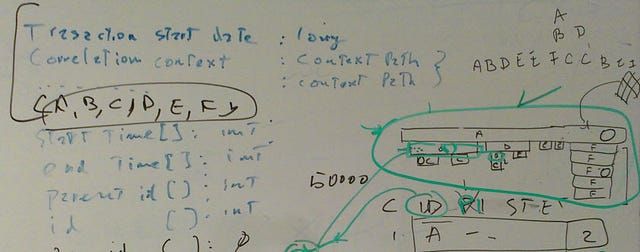
When we all came in to work the next day, we had to go to a meeting where Peter spoke to us about his new product direction. Everyone had to drop what they were doing and participate, even the asocial QA engineers who maintained the automatic test suites, and whose work was so far from anything a customer would actually do that they sat in meetings squinting and huddling together like trapped possums. Peter’s new product direction meant that we would spend the next two weeks brainstorming, mission-visioning, and stake-holding. We would fill a wall-sized whiteboard with copious diagrams, break for lunch, and then go into a different conference room where another team had been working that morning to create a similar diagram. It would resemble the one we’d made, except whereas ours was like the plan for a combination football play, tank battle and high school prom, theirs was like the combined plans for a major political convention, bank heist and space shuttle rescue mission. We’d erase it and cover the board with another, just as crazy-looking diagram. And then the next day we’d start all over. Vinay, a new project manager whom Peter had hired from the company they both used to work at, was assigned to translate it all into project plans. He grew more and more haggard as the days went by. I sat next to him once and saw that he was taking notes in three different applications at once, including an Excel spreadsheet that had more tabs than I could count.
In the middle of the second week, Vinay failed to come back after lunch. Geeta was dispatched to find him, and after fifteen minutes, when she didn’t come back, they sent me. I went to Vinay’s cube and found him slumped in his chair crying, with Geeta and Vinay’s predecessor Prasad standing over him. Geeta was on the phone with someone, and soon the HR girl Julie Wong showed up, took in the situation, and led Vinay away.
Geeta turned to Prasad and said: “Bring your laptop and come to the Denver Conference Room. You will be the project manager again.”
Prasad grimaced. “I have my job back. Woo hoo,” he said glumly.
She said, “Boo hoo or woo hoo, somebody has to do it. I’ll see you in five minutes.” No wonder Peter had made her the new team lead.
At the end of two weeks, each team had to present its ideas to Peter. Our idea for a product was a frontend application development environment that would sit on top of the Moment application platform, taking the place of the messy collection of tools that Professional Services had hacked together for years. There were lots of development applications already, built by other companies like Oracle and Inseeq and BEA (before Oracle bought them), but our idea was to steal their best features, provide additional proprietary extensions, and bundle it with special pricing with the core Moment app platform. We called it the Moment Builder.
Peter, Robert and Albert sat as a panel of judges for the presentation, and Geoff presented for our team. When he was finished, he stood sweating in front of them, awaiting their questions. Albert was looking at Robert to see whether or not he liked the idea, but Peter was staring straight ahead. Then he barked out: “Turn off the projector!”
Someone hit the projector switch, which automatically raised the projection screen as well. Peter walked to the whiteboard, which was covered with one of the chaotic diagrams. He picked up an eraser and swiftly obliterated a space in its center. Then he wrote in big letters: BUILD MOMENTUM.
“It isn’t Moment Builder,” he said, “it’s Build Momentum. And we’re going to have another product, a performance tuning application, and we’ll call it Gain Momentum. And we’ll bundle everything we’ve got and ship it all together and call that Enterprise Momentum. Geoff, where’s your team? Let’s hear it for Geoff’s team, everyone.”
After the applause died down, Jim the director spoke up. “We don’t have a performance tuning application, actually,” he said. And Steve, a QA engineer who was on someone else’s team, pointed out that they hadn’t even presented yet.
“Is your product idea a performance tuning app?” Peter asked Steve. “No? Congratulations, you’re now the Gain Momentum team. Go design a performance tuning app. We’ll look at your design in two weeks. Jim, turn these product design teams into development teams. Just the way we’ve been working, we’ll have coders, testers, tech writers, a product manager, each role on each team. This is everybody who isn’t working on the core server already. Tonight there’s a special dinner for this new group, Justine will give you the details. After that I want you to go home and have a great weekend saying goodbye to your families, because you’re going to be seeing very little of them for the next twelve months. I want this in customers’ hands by the Moment World conference next year. Any questions? Too many questions,” he concluded, seeing everyone’s hands go up. “We’ll have to take it off-line.”
“Directions to the dinner is in your email!” Justine screeched. “It’s at Wente, Wente! Use the directions!”
We got to the dinner eventually. Even though Jonathan was driving.
——-
This is an excerpt from a novel in progress, “Knock Yourself Out.”